
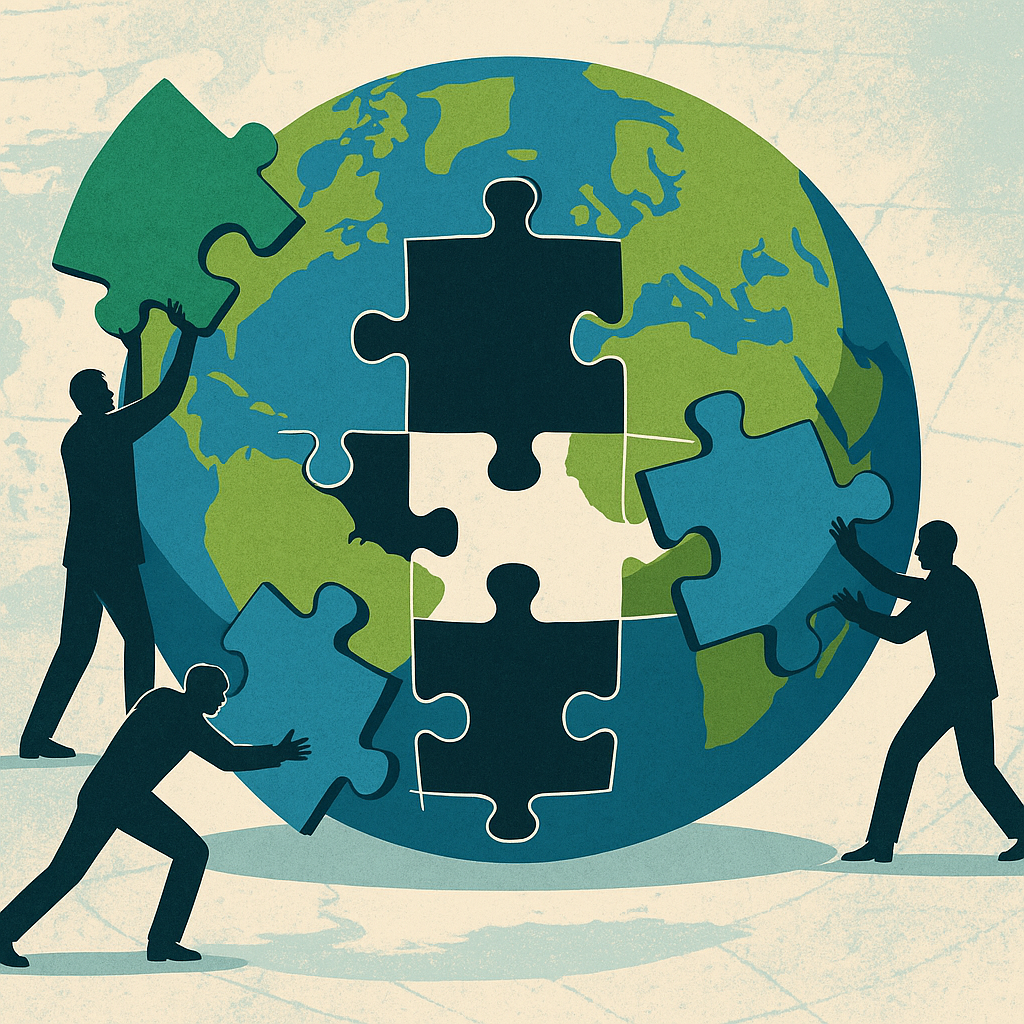
What begins as a simple economic forecast can sometimes blossom into a formidable geopolitical entity. Such is the story of BRICS. The journey from a catchy acronym, coined in the sterile environment of an investment bank, to a sprawling intergovernmental organization representing nearly half the world’s population is a testament to the shifting tectonic plates of global power. It’s a narrative of ambition, expansion, and the collective will of emerging economies to carve out a more significant space for themselves on the world stage.
Outline
- Genesis of the BRIC idea (2001 Goldman Sachs paper)
- Political birth (2006 meetings) and first summit (2009)
- South Africa’s entry and the birth of “BRICS” (2011)
- The Kazan–Johannesburg double-step expansion of 2024-25
- The new “partner-country” tier and Vietnam’s arrival
- Rotating presidencies and the looming need for a fresh rotation formula
The tale starts not in a grand hall of diplomacy, but within a 2001 Goldman Sachs paper. There, the term “BRIC” was born, a label for four nations—Brazil, Russia, India, and China—whose rapid economic growth projected them as the future titans of the global economy. This economic concept, however, soon took on a political life of its own. The foreign ministers of these four nations initiated a formal dialogue in 2006, a conversation that culminated in the first-ever BRIC Leaders’ Summit in Yekaterinburg, Russia, in 2009. The transformation from an analyst’s projection to a formal grouping was complete.
Milestones in Membership
| Year | Event | Resulting Acronym |
| 2001 | Goldman Sachs paper | BRIC (idea) |
| 2006 | First ministerial in New York | BRIC (political) |
| 2009 | Yekaterinburg summit | BRIC (formal) |
| 2011 | South Africa admitted | BRICS |
| 2024 | Egypt, Ethiopia, Iran, UAE admitted | BRICS (11) |
| 2025 | Indonesia added | BRICS (11, revised) |
Yet, the evolution was far from over. The bloc’s first expansion occurred in 2011 with the strategic inclusion of South Africa, adding an “S” to the acronym and giving the group a crucial foothold on the African continent. A more dramatic enlargement unfolded starting in 2024, as Egypt, Ethiopia, Iran, and the United Arab Emirates were welcomed as full members. This was swiftly followed by Indonesia’s accession in January 2025, solidifying the group’s presence in the Middle East, Africa, and Southeast Asia. This rapid growth underscores a potent magnetic pull, transforming the original quartet into a diverse eleven-member coalition, fundamentally altering its character and its potential global impact.