
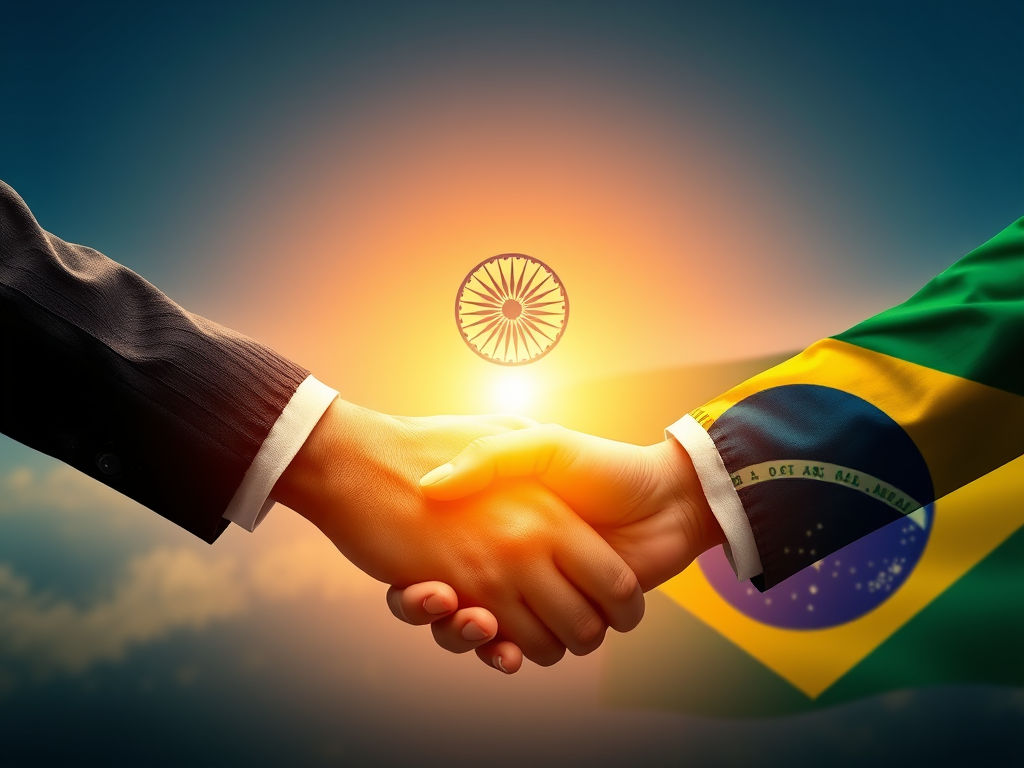
Brasilia/New Delhi – In the grand theatre of global geopolitics, where alliances shift like desert sands, the steadfast and burgeoning relationship between India and Brazil stands as a testament to shared values and a harmonized vision for the future. It’s a partnership that transcends mere diplomatic niceties, rooted in a history that stretches back centuries and blossoming today into a multifaceted strategic alliance that is as dynamic as it is deep. This is not just a story of two emerging economies finding common ground; it is the narrative of two continental democracies, diverse and vibrant, charting a course for a more inclusive and prosperous world order, together.
From the outposts of the Portuguese empire to the high tables of the G20 and BRICS, the journey of India and Brazil has been one of converging paths. What began with faint, almost forgotten, historical echoes—exchanges between colonial Brazil and Portuguese Goa, the curious case of Indian cattle forming the backbone of Brazil’s livestock industry—has matured into a robust, institutionalized partnership. Elevated to a Strategic Partnership in 2006, the bond is anchored in a shared commitment to democratic principles, social inclusion, and a relentless pursuit of economic growth that uplifts all citizens.
This is a relationship nurtured at the highest levels, marked by a consistent and increasingly frequent tempo of presidential and prime ministerial visits that have provided a sustained impetus, transforming shared intentions into concrete actions. It is a story told not just in joint communiqués, but in the collaborative hum of satellites in space, the joint ventures of pharmaceutical giants, and the quiet appreciation for yoga and Ayurveda in the heart of South America.
A Symphony of Summits: The Political Cadence
The health of any bilateral relationship can often be gauged by the frequency and warmth of its high-level exchanges. In this regard, the India-Brazil corridor has been exceptionally busy, forging a powerful political consensus that drives the partnership forward. The period since the formalization of the Strategic Partnership in 2006, in particular, has witnessed a remarkable acceleration in these engagements.
The state visit of then-President Jair Bolsonaro to India in January 2020 was a watershed moment, not just for his role as the Chief Guest at India’s Republic Day Parade, but for the tangible outcomes it produced. The adoption of a comprehensive Action Plan provided a clear, ambitious roadmap, while the signing of fifteen agreements across sectors as diverse as cyber security, bio-energy, and traditional medicine laid the groundwork for a new era of cooperation.
This momentum is a two-way street, built on decades of mutual respect. The footsteps of Indian leaders, from Vice President Dr. S. Radhakrishnan in 1954 and Prime Minister Indira Gandhi in 1968 to the more recent, frequent visits by Prime Minister Narendra Modi and his predecessors, have left indelible marks in Brasilia. Similarly, Indian cities have rolled out the red carpet for Brazilian presidents, fostering a personal chemistry between leaders that translates into national policy.
A Chronicle of High-Level Engagements
| VVIP Visits from India to Brazil | VVIP Visits from Brazil to India |
| Dr. S. Radhakrishnan, Vice President (1954) | Mr. Fernando Henrique Cardoso, President (1996) |
| Ms. Indira Gandhi, Prime Minister (1968) | Mr. Luiz Inacio Lula da Silva, President (2004, 2007, 2008, 2023) |
| Dr. Manmohan Singh, Prime Minister (2006, 2010, 2012) | Ms. Dilma Rousseff, President (2012) |
| Ms. Pratibha Patil, President (2008) | Mr. Jair Bolsonaro, President (2020) |
| Shri Narendra Modi, Prime Minister (2014, 2019, 2024) |
This dialogue extends seamlessly to the parliamentary level, creating a rich, multi-layered political conversation. Active India-Brazil Parliamentary Friendship Groups in both chambers of the Brazilian Congress and a historical counterpart in the Indian Lok Sabha ensure that the legislative branches are active participants in this evolving story. Recent visits, such as the one led by Indian Speaker Shri Om Birla in June 2025 for the BRICS Parliamentary Forum, and a multi-party delegation led by Dr. Shashi Tharoor to brief Brazilian counterparts on critical security issues, underscore the depth and seriousness of this legislative engagement.
The Architectural Framework: Mechanisms of Cooperation
Behind the pageantry of state visits lies the intricate and essential machinery of bilateral cooperation. India and Brazil have meticulously constructed a robust architecture of institutional mechanisms to ensure that their strategic partnership is not just a declaration, but a functioning reality.
This framework allows for regular and structured dialogue across a gamut of sectors. At the apex is the Joint Commission Meeting (JCM), helmed by the foreign ministers, which provides overall strategic direction. The 9th JCM, held in New Delhi in August 2024, co-chaired by Dr. S. Jaishankar and Ambassador Mauro Vieira, is a recent example of this high-level oversight.
Supporting this are a host of specialized bodies: the Strategic Dialogue between National Security Advisors, the Foreign Office Consultations at the Secretary level, the crucial Trade Monitoring Mechanism (TMM) steering the economic relationship, and Joint Committees dedicated to defence, science and technology, and more. These are the forums where potential is translated into policy, and policy into projects. From a 2+2 Political-Military dialogue to a Joint Working Group on Bioenergy, this elaborate network ensures that every facet of the relationship receives focused attention, fostering collaboration that is both broad and deep.
The Economic Engine: Trade, Investment, and Shared Prosperity
The economic dimension of the India-Brazil relationship is a powerhouse, driving growth and creating opportunities in both nations. The numbers speak for themselves. In the fiscal year 2024-25, bilateral trade surged to an impressive $12.20 billion. This vibrant commercial exchange saw Indian exports to Brazil reach $6.77 billion, with imports standing at $5.43 billion, reflecting a healthy and balanced trade relationship.
Bilateral Trade Snapshot (2024-25)
| Metric | Value (USD) |
| Total Bilateral Trade | $12.20 billion |
| Indian Exports to Brazil | $6.77 billion |
| Indian Imports from Brazil | $5.43 billion |
The trade basket is remarkably diverse, showcasing the complementary nature of the two economies. India ships processed petroleum products, a vast array of agro-chemicals, pharmaceuticals, and engineering goods to Brazil. In return, Brazil fuels India’s growth with crude oil, soya oil, gold, raw sugar, and cotton. This is a trade relationship that supports key industries and consumers in both countries.
Investment flows further cement this economic embrace. Indian companies have recognized the immense potential of the Brazilian market, investing over $6 billion. Giants like Sun Pharma, Tata Motors, Infosys, and ONGC Videsh have established a significant presence. The sentiment is mutual, with Brazilian firms like automotive-maker Polo and IT major Stefanini investing around $1 billion in India, weaving their operations into the fabric of the Indian economy.
Partners in Progress: From Space to Soil
The India-Brazil development partnership is a compelling narrative of South-South cooperation in action. It spans the final frontiers of space and the foundational sectors of agriculture and energy, demonstrating a shared commitment to leveraging technology and knowledge for national development.
In the realm of Space Cooperation, a 2004 framework agreement has led to fruitful collaboration in satellite tracking and data sharing. A landmark achievement was the launch of Brazil’s Amazonia-1 satellite by the Indian Space Research Organisation (ISRO) in 2021. This was not just any launch; it was Brazil’s first Earth Observation satellite to be entirely designed, integrated, tested, and operated by Brazil, a moment of immense national pride facilitated by Indian launch capabilities.
The energy sector is another cornerstone of this partnership. With Indian public sector undertakings investing $3.5 billion in Brazil’s upstream Oil & Gas sector, Brazil has become India’s largest upstream investment destination in the Americas. This engagement is crucial for India’s energy security. Simultaneously, the two nations are pioneering the future of clean energy. As a co-founder of the Global Biofuel Alliance launched during its G20 presidency, India sees a natural and powerful partner in Brazil, a global leader in Biofuels. MoUs and Joint Working Groups are actively aligning India’s ‘National Biofuel Policy’ with Brazil’s ‘Renova Bio’ program, a collaboration that holds immense promise for global energy sustainability.
This spirit of cooperation permeates other critical areas. In Defence, a 2003 agreement has institutionalized collaboration through a Joint Defence Committee, leading to frequent exchanges and training for over 134 officers from both sides. The partnership is also looking at the future, with burgeoning interest in Digital Technology, including data protection architecture, 5G/6G networks, and Artificial Intelligence.
Even the very soil of the two nations is connected. The remarkable genetic heritage shared by Indian and Brazilian cattle—with Indian breeds like Gir and Kankrej having been exported and adapted in Brazil to become prolific milk producers—is a unique and historical tie. Today, this connection has evolved into modern Agricultural cooperation focusing on technology transfer and food safety standards.
The Cultural Connect: A Shared Soul and a Vibrant Exchange
Beyond the strategic calculations and economic figures lies the true heart of the India-Brazil relationship: a deep and genuine cultural affinity. There is an immense fascination in Brazil with Indian culture, philosophy, and arts, creating a vibrant people-to-people connection that policy alone cannot forge. The first cultural waves from India to wash upon Brazilian shores were spiritual and philosophical, finding a ready audience. This connection has since blossomed into a widespread appreciation that mirrors Brazil’s own jolly and colorful festive nature, seen in the folkloric dances and parades of its north and northeast.
The classical arts of India have found a second home in Brazil. Bharatanatyam was the first to arrive, its intricate gestures and powerful storytelling captivating audiences, soon followed by the fluid grace of Odissi and the rhythmic brilliance of Kathak and Kuchipudi. This artistic appreciation is complemented by a profound interest in India’s ancient wellness traditions. Yoga and Ayurveda are not just niche practices; they are institutionalized and celebrated. Numerous organizations teach Yoga across the vast country, and spiritual gurus and foundations like the Ramakrishna Mission, ISKCON, and the Art of Living have flourishing chapters. The Brazilian Association of Ayurveda (ABRA), a non-profit with a presence in nine states, showcases the serious, organized pursuit of this ancient science of life. This dedication has been highlighted by major events like the International Congress on Ayurveda, held in Goias in 2013 and again in Rio de Janeiro in 2018, the latter drawing over 4,000 delegates.
The International Day of Yoga (IDY) has become a major annual event. Since its inception, celebrations have been held in major cities across Brazil. In 2015, the occasion was marked by a congratulatory exchange between the leaders of both nations and the issuance of a commemorative stamp by Brazil Post—a gesture repeated for the centenary of Indian Cinema. The Indian Embassy in Brasilia has been a hub of activity, with its immensely popular yoga classes growing from thrice to four times a week, attracting locals and the diplomatic community alike.
The moral and philosophical leadership of Mahatma Gandhi is another powerful, connecting thread. He is deeply revered, with his philosophy of non-violence being actively inculcated among students, youth, and even police forces. Statues of the Mahatma in Rio de Janeiro, Sao Paulo, and Londrina stand as permanent tributes. In Salvador, the hugely popular organization Filhos de Gandhy (Sons of Gandhi) takes out annual street processions in Gandhian attire, a vibrant and unique expression of his enduring legacy.
This cultural exchange is a dynamic, two-way conversation, actively curated by diplomatic missions. Indian cinema, made famous by the wildly popular TV Globo serial ‘Caminho das Indias’ (Paths of India), has a dedicated following, bolstered by regular film festivals. The ‘Food Week of India’ introduces Brazilians to the subcontinent’s diverse cuisines. A dazzling “Festival of India” in 2017, celebrating 70 years of Indian independence, brought a rich tapestry of Gandhian exhibitions, Carnatic and Kathak performances, and literary exchanges to Brasilia, São Paulo, and Rio de Janeiro. The Embassy also hosts unique events like ‘Chá com Letras’ (Tea with Letters), a platform for Brazilian poets, and has undertaken a concerted effort to promote the distinct cultures of Indian states, with evenings dedicated to Rajasthan, Goa, Punjab, Bihar, and Karnataka. This has included everything from Kalbelia dance performances to the launch of the Portuguese translation of A.K. Ramanujan’s famous collection of Kannada folktales, “Uma Arvore em Flor.” The result is a relationship that is not just strategic, but also deeply felt, celebrated through music, dance, food, and shared ideas.
Forging Future Minds: Education and Technical Cooperation
Building on this strong foundation, the partnership actively invests in its human capital through educational and technical cooperation. The Indian Technical and Economic Cooperation (ITEC) programme is a key pillar of this effort. This flagship capacity-building initiative has seen around 55 Brazilians travel to India over the past seven years for specialized training in diverse fields such as communications, management, and defence. The growing popularity of these courses signifies a keen interest among Brazilian professionals to learn from India’s developmental experience and technical expertise, forging lasting professional and personal networks in the process.
A Living Bridge: The Indian Community
The Indian community in Brazil, though numbering a modest 4,700 people, plays an outsized role as a living bridge between the two nations. Concentrated primarily in the bustling hubs of Sao Paulo, Rio de Janeiro, and Manaus, the community is a vibrant mix of professionals, businessmen, and highly skilled scientists and researchers contributing to Brazil’s advancement in fields like space, agriculture, physics, and biotechnology. Organized through bodies such as the Indian Association in Sao Paulo, they are crucial actors in this positive story, serving as informal ambassadors of Indian culture and enterprise and strengthening the grassroots connections that underpin the formal strategic partnership.
In conclusion, the relationship between India and Brazil is a rich tapestry woven with threads of shared history, common values, strategic convergence, and profound cultural affection. It is a partnership of equals, a collaboration between two of the world’s most significant developing nations, moving forward with a sense of shared purpose and immense optimism. As they navigate the complexities of the 21st century, the synergy between New Delhi and Brasilia is not just beneficial for their billion-plus citizens; it is a powerful force for shaping a more balanced and equitable global order. The path ahead is bright, and the embrace between these two giants of the Global South is only set to grow deeper and stronger.