
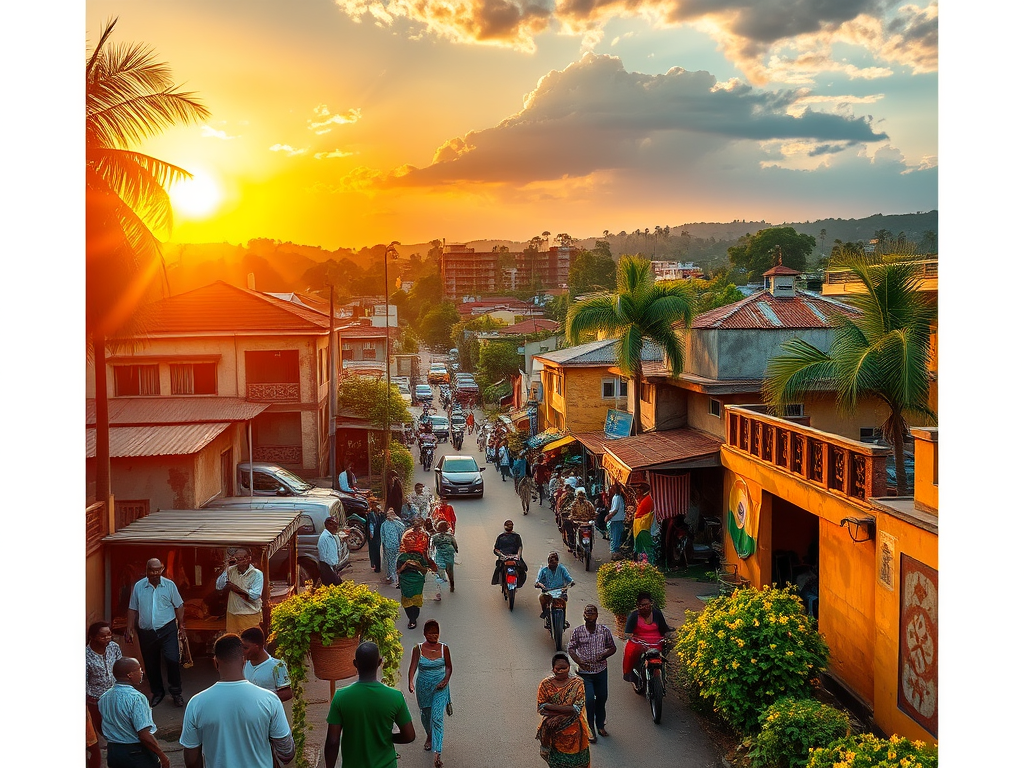
Nestled on the West African coast, washed by the Atlantic, the Republic of Ghana stands as a compelling portrait of stability and potential. It is more than just a geographical location; it is a vibrant confluence of diverse ethnicities, a bastion of constitutional democracy in a sometimes-turbulent region, and an economic engine demonstrating remarkable resilience and opportunity. To understand Ghana is to understand a nation whose youthful demographic profile, rich resource base, and stable political landscape make it a linchpin for regional progress and a pivotal partner for global economies like India.
This is a deep dive into the fabric of Ghana—its people, its politics, and its economic pulse—and the flourishing bilateral corridor of trade and investment it shares with India, a relationship animated by a dynamic and deeply-rooted diaspora.
Ghana at a Glance: A Nation of Rich Diversity
To comprehend Ghana, one must first appreciate its sheer diversity. It is a nation of significant scale, with a land area of over 227,000 square kilometers, of which a remarkable 35.1% remains forested. Its tropical climate nurtures the land and its people—a young and growing population of over 30.8 million, with more than a third under the age of 15. This youthful energy is a powerful asset for future growth.
The social tapestry is intricate and rich. While English is the official language of governance and commerce, it exists alongside approximately 60 other local languages, with Akan, Ewe, and Dagbani being prominent. This linguistic diversity is mirrored in its ethnic composition, a harmonious blend where the Akan (45.7%), Mole-Dagbani (18.5%), and Ewe (12.8%) are the largest groups. This mosaic is bound by a shared national identity and a climate of religious tolerance, with a Christian majority (71.3%) coexisting peacefully with a substantial Muslim community (19.9%) and adherents of traditional faiths.
Ghana: Key National Statistics
Population | 30.83 million | Ghana PHC, 2021 | |
Capital | Accra |
Ethnic Groups | Akan (45.7%), Mole-Dagbani (18.5%), Ewe (12.8%) | 2021 est. | |
Religion | Christian (71.3%), Muslim (19.9%) | 2021 est. | |
Urbanisation | 59.24% | Statista, 2023 | |
Internet Penetration | 69.8% | Jan 2024 |
The Political Bedrock: A Bastion of Democracy
In an era where democratic norms face global pressures, Ghana’s political structure is a testament to enduring stability. As a Unitary Republic and a constitutional democracy, its governance is built on a solid foundation. The political landscape is predominantly shaped by two major parties, the National Democratic Congress (NDC) and the New Patriotic Party (NPP), creating a competitive and mature democratic environment that ensures accountability and smooth transitions of power.
The government is presidential in form, with the Head of State, H.E. Mr. John Dramani Mahama, leading the nation.His re-election for a second term in the December 2024 polls, where his party, the NDC, secured a strong parliamentary majority with 183 of the 276 declared seats, signals a mandate for continuity and a stable policy environment—a critical factor for both citizens and international investors.
The Economic Engine: Resilience and Diversified Growth
Ghana’s economy presents a narrative of dynamic growth and increasing sophistication. With a GDP of USD 75.31 billion (IMF, 2024) and a stunning real GDP growth rate of 7.2% reported in the third quarter of 2024, the country is on a powerful economic trajectory.
What is particularly striking is the balanced composition of its economy. While many resource-rich nations struggle to diversify, Ghana has cultivated a robust, multi-sectoral engine for growth:
- Services (42.9%): The largest contributor, indicating a modernizing economy.
- Industry (32.6%): A strong industrial base, fueled by natural resources and manufacturing.
- Agriculture (24.5%): A vital sector, ensuring food security and providing livelihoods.
The country’s top exports—Gold bullion, crude petroleum, and cocoa paste—are formidable foreign exchange earners.While challenges such as an 18.4% inflation rate and an external debt of USD 27.9 billion persist, the strong growth, significant FDI inflows of USD 316 million in the first three quarters of 2024, and substantial Official Development Assistance (ODA) underscore a fundamental confidence from the global community in Ghana’s economic management and future prospects.
The Commercial Corridor: A Story of Symbiotic Partnership
The economic synergy between India and Ghana is perhaps one of the most vibrant facets of their relationship. The bilateral trade figures speak for themselves, charting a course of explosive growth.
India-Ghana Bilateral Trade (in millions of USD)
| Fiscal Year | India’s Exports | India’s Imports | Total Trade |
| 2020-21 | 862.50 | 1,374.96 | 2,237.46 |
| 2022-23 | 964.17 | 1,909.59 | 2,873.76 |
| 2024-25 | 1,346.75 | 1,790.54 | 3,137.29 |
This commercial corridor saw trade volumes soar past USD 3.1 billion in the 2024-2025 fiscal year. The relationship is notably complementary: India exports essential goods like pharmaceuticals, vehicles, iron, and steel to Ghana, while it is a major importer of Ghanaian gold, cocoa, nuts, and timber.
This trade is cemented by a strong investment relationship. Indian Foreign Direct Investment (FDI) has been a significant driver of growth in Ghana, totaling USD 2.2 billion between 1994 and 2021 and continuing with tens of millions in new projects annually across agriculture, pharmaceuticals, and manufacturing.
Animating this entire economic partnership is the Indian community. The 15,000-strong diaspora, including Persons of Indian Origin (PIOs) who have called Ghana home for over 70 years, acts as a crucial catalyst. Their deep-rooted business activities and the continuous influx of skilled Indian professionals are acknowledged as major contributions to the economic development of Ghana. They are not merely investors; they are economic ambassadors, embodying the trust and mutual benefit that define the Indo-Ghanaian success story.