
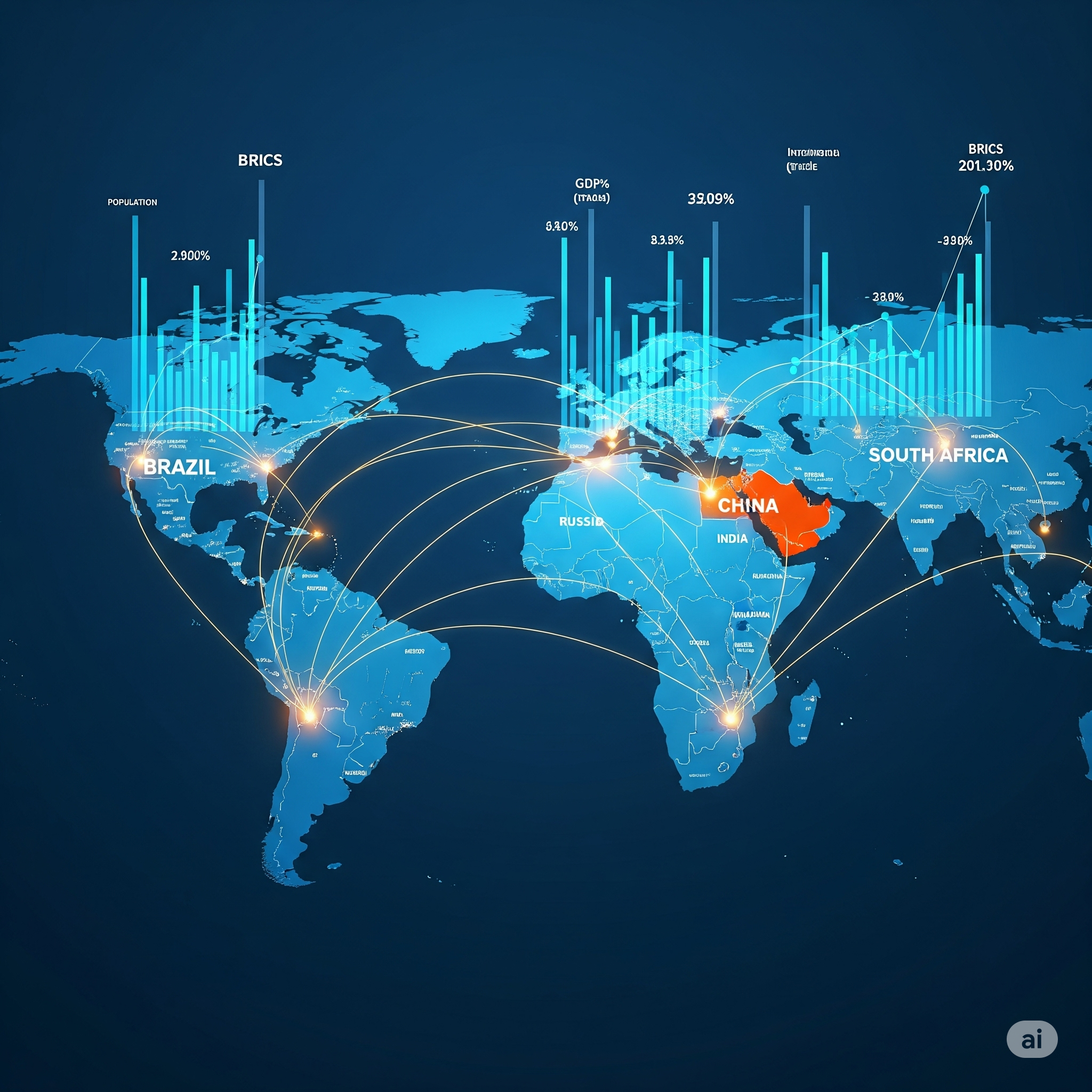
The sheer scale of the expanded BRICS bloc is staggering, a fact often lost in geopolitical discourse but starkly revealed by the underlying data. This is not merely a collection of developing nations; it is a global heavyweight whose demographic and economic mass demands attention. When a single group accounts for nearly half the planet’s people and a significant chunk of its economic and resource output, the world is compelled to take notice. The numbers don’t just tell a story; they roar.
The collective might of the eleven BRICS nations represents a formidable force in the global arena. Their combined power reshapes economic and demographic maps, highlighting a significant concentration of global influence.
| BRICS Share of Global Total | |
| Population | ~ 49.5% |
| Gross Domestic Product (GDP in PPP) | ~ 39% |
| International Trade | ~ 26% |
| Territorial Land Mass | ~ 36% |
| Global Oil Production | ~ 43.6% |
| Global Natural Gas Production | ~ 36% |
| Global Coal Production | ~ 78.2% |
| Reserves of Rare Earth Minerals | ~ 72% |
Beyond population and GDP, the group’s dominance extends to strategic resources, giving it immense leverage. Commanding approximately 43.6% of global oil production and 72% of the world’s rare earth mineral reserves, BRICS holds the keys to both the industrial economies of today and the green technologies of tomorrow. This concentration of critical resources, coupled with its immense human capital and growing share of global trade, positions the bloc not just as a participant in the global economy, but as a central, indispensable pillar upon which much of the world’s future development will rely.