
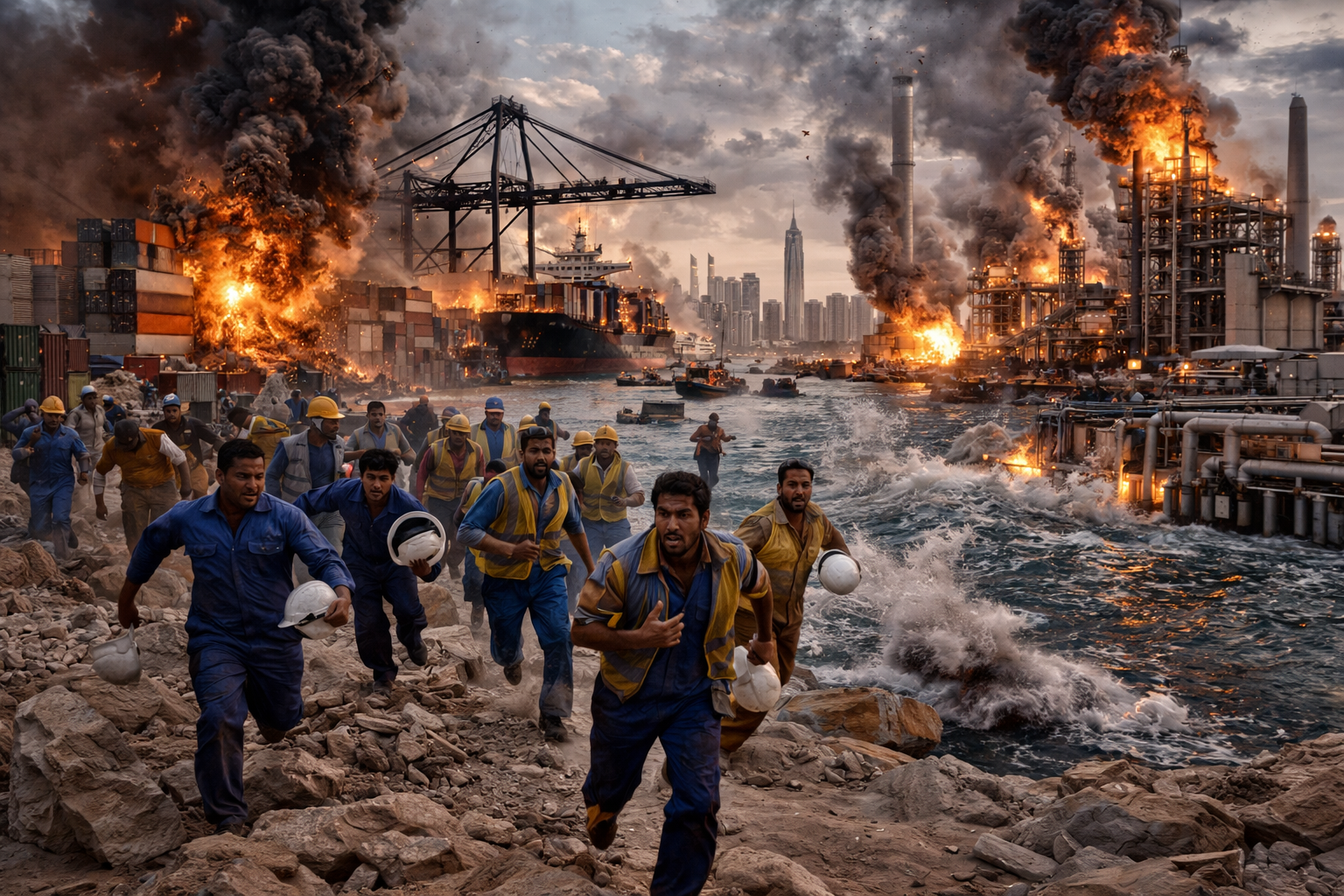
One of the most important shifts in the war is that it has become unmistakably regional. On 25 March, Volker Türk said the conflict was affecting Bahrain, Kuwait, Oman, Qatar, Saudi Arabia, the United Arab Emirates and Jordan, with drones and missiles hitting military bases, residential areas and energy facilities. He said ports, airports, water infrastructure and diplomatic premises had also been damaged.
The significance of that list is practical, not rhetorical. These are states built around logistics, energy exports, desalination and migrant labour. When the UN human-rights office says ports and water systems are being hit, it is describing damage to the everyday machinery of urban life. Türk later pointed specifically to a desalination plant in Bahrain, warning that tit-for-tat attacks on essential infrastructure could carry dire consequences across the region.
Migrant workers are especially exposed. OHCHR said several had already been killed or injured, while others were trapped and unable to return home. It added that remittance flows were at risk. That matters because the Gulf does not simply host migrant labour; it runs on it. A war that interrupts work sites, housing, ports, airports and payment systems does not remain a military matter for long. It becomes a labour-market shock with international social effects.
The UN Human Rights Council has begun treating this spread as a matter requiring formal debate. Official OHCHR listings show urgent attention in late March both to the Minab school strike in Iran and to the impact of Iranian attacks on GCC countries and Jordan. That alone tells us how far the battlefield has widened.
| Civilian system | Verified concern | Why it matters |
| Ports and airports | Damage reported by OHCHR | Trade and passenger movement are vulnerable |
| Water systems | Bahrain desalination plant affected | Water security is a core civilian issue in the Gulf |
| Energy facilities | Repeatedly cited by OHCHR | Revenue, power and export reliability are at risk |
| Migrant labour | Workers killed, injured or trapped | Remittances and household incomes beyond the Gulf are affected |