
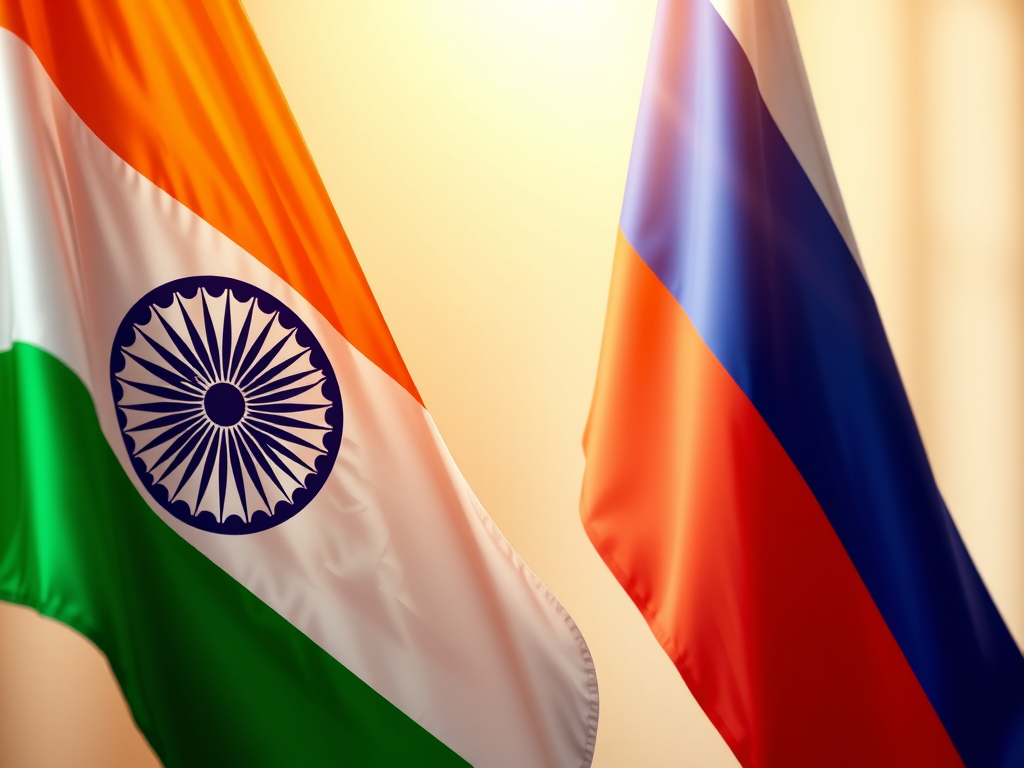
When independent India began shaping its foreign policy, it looked for partners who respected its sovereignty, civilisational confidence and strategic autonomy. Over nearly eight decades, Russia has consistently been one of those partners, evolving from the Soviet era’s solidarity to today’s “Special and Privileged Strategic Partnership” that spans the entire spectrum of political, economic, defence, nuclear, space and people-to-people cooperation.
Early Foundations: Trust Forged in the Cold War
Formal diplomatic relations between India and the then Soviet Union began in 1947–48, in the turbulent aftermath of the Second World War. India, newly independent, refused to be drawn into military blocs and instead chose non-alignment. Yet, even within this framework, Moscow quickly emerged as a pivotal partner for New Delhi, backing India on critical issues such as Kashmir and providing vital industrial, defence and technological support when few others were willing to do so.
The 1971 Treaty of Peace, Friendship and Cooperation between India and the Soviet Union became a defining political moment. Signed against the backdrop of the crisis in East Pakistan, it signalled an extraordinary degree of mutual confidence. The Treaty underlined that India’s pursuit of strategic autonomy could go hand in hand with deep, issue-based alignment with a major power when Indian interests required it.
Strategic Partnership and the Annual Summit Era
The transformation of this legacy relationship into a modern strategic partnership came with the “Declaration on the India–Russia Strategic Partnership” in October 2000, during President Vladimir Putin’s visit to India. This agreement created a dense web of institutional mechanisms and launched the practice of Annual Summits between the Indian Prime Minister and the Russian President – a unique feature that few of India’s partnerships enjoy.
Over time, this architecture was further upgraded. In 2010, the relationship was elevated to a “Special and Privileged Strategic Partnership”, acknowledging the exceptional depth and trust that had developed between the two sides.
The Annual Summits have become anchor points for political guidance and new initiatives. So far, 22 Summits have been held alternately in India and Russia, sustaining high-level contact even in times of global flux. The 22nd Annual Summit in Moscow in July 2024 issued a Joint Statement titled “India–Russia: Enduring and Expanding Partnership” and a separate Leaders’ Joint Statement on strategic areas of economic cooperation up to 2030, underlining that both sides see long-term convergence in a multipolar world.
Prime Minister Narendra Modi was also conferred Russia’s highest state decoration, the Order of Saint Andrew the Apostle the First-Called, for his contribution to India–Russia ties – a symbolic moment that captured the political warmth between the two leaderships.
Institutional Architecture: Talking at Every Level
What gives the partnership resilience is its institutional depth. At the apex are the Annual Summits. These are complemented by:
- The India–Russia Intergovernmental Commission (IRIGC) with two pillars:
- IRIGC-TEC on Trade, Economic, Scientific, Technological and Cultural Cooperation, co-chaired by India’s External Affairs Minister and Russia’s First Deputy Prime Minister.
- IRIGC-M&MTC on Military and Military-Technical Cooperation, co-chaired by both Defence Ministers.
- Since December 2021, a 2+2 Dialogue of Foreign and Defence Ministers has further strengthened the political-strategic conversation, mirroring similar formats India has with a select group of major partners.
- Regular meetings at the level of National Security Advisers, Foreign Office Consultations between the Foreign Secretary and Russian Deputy Foreign Ministers, and numerous working groups on counter-terrorism, the United Nations and regional issues ensure that there are few surprises in the relationship.
This layered architecture allows New Delhi and Moscow to compare notes on regional and global developments, manage differences and explore new opportunities.
Parliamentary and Political Outreach
The political relationship is not confined to the executive. The Inter-Parliamentary Commission between the Lok Sabha and the Russian State Duma has met several times since its inception in 2000, helping build a constituency of support across party lines in both countries.
In May 2025, an all-party delegation from India visited Russia in the context of the Pahalgam terror attack and India’s Operation Sindoor, underscoring India’s united front against terrorism and using parliamentary diplomacy to reinforce this message in Moscow.
Defining Visits and Political Milestones
Several high-level visits have acted as inflection points:
- Prime Minister Modi’s visit to Vladivostok in 2019, which launched a new focus on the Russian Far East and connectivity.
- The 21st Annual Summit in December 2021, which saw the launch of the 2+2 framework and the signing of a programme on military-technical cooperation for 2021–2031.
- The Moscow Summit of July 2024, which set out economic priorities till 2030 and reaffirmed cooperation on energy, connectivity and high technology.
Repeated interactions on the sidelines of BRICS, SCO and the G20 – including the BRICS Summit in Kazan in October 2024 – ensure political contact even in years without a bilateral summit in New Delhi or Moscow.
Multilateral Convergence and Strategic Autonomy
India and Russia frequently find themselves on the same side of debates on global governance. Both support a more multipolar world order, resist new forms of bloc politics and call for respect for international law and the UN Charter. Moscow has consistently backed India’s candidature for a permanent seat in a reformed UN Security Council, a key Indian diplomatic priority.
Within BRICS, the SCO and the G20, the two countries coordinate positions on terrorism, climate change, energy security and reforming international financial institutions. During India’s G20 and SCO presidencies in 2023 and Russia’s BRICS chairship in 2024, the consultation channels were particularly active.
At the same time, India has preserved strategic autonomy – for example in its nuanced approach to crises such as Ukraine, focusing on diplomacy, dialogue and the interests of the Global South. New Delhi’s ability to maintain high-level political engagement with Moscow while also deepening other strategic partnerships is, in itself, a demonstration of Indian diplomatic capacity.
Looking Ahead: Political Will for a New Century
The India–Russia political partnership has remained remarkably steady through leadership changes, economic reforms, and shifting global alignments. From the early days of steel plants and heavy industry to cooperation on nuclear energy, space, the Arctic and advanced defence technologies, Russia has been a companion in India’s rise.
As both countries look to the coming decade, they are increasingly focused on:
- New geographies – the Russian Far East and Arctic;
- New domains – digital technologies, space, green energy and critical minerals;
- New mechanisms – local currency settlement, alternative connectivity corridors and greater inter-regional cooperation.
For India, the political relationship with Russia is not about nostalgia. It is about leveraging a time-tested partnershipin a rapidly changing world, while staying true to the principles of sovereignty, independence and strategic autonomy that have guided Indian foreign policy since independence.