
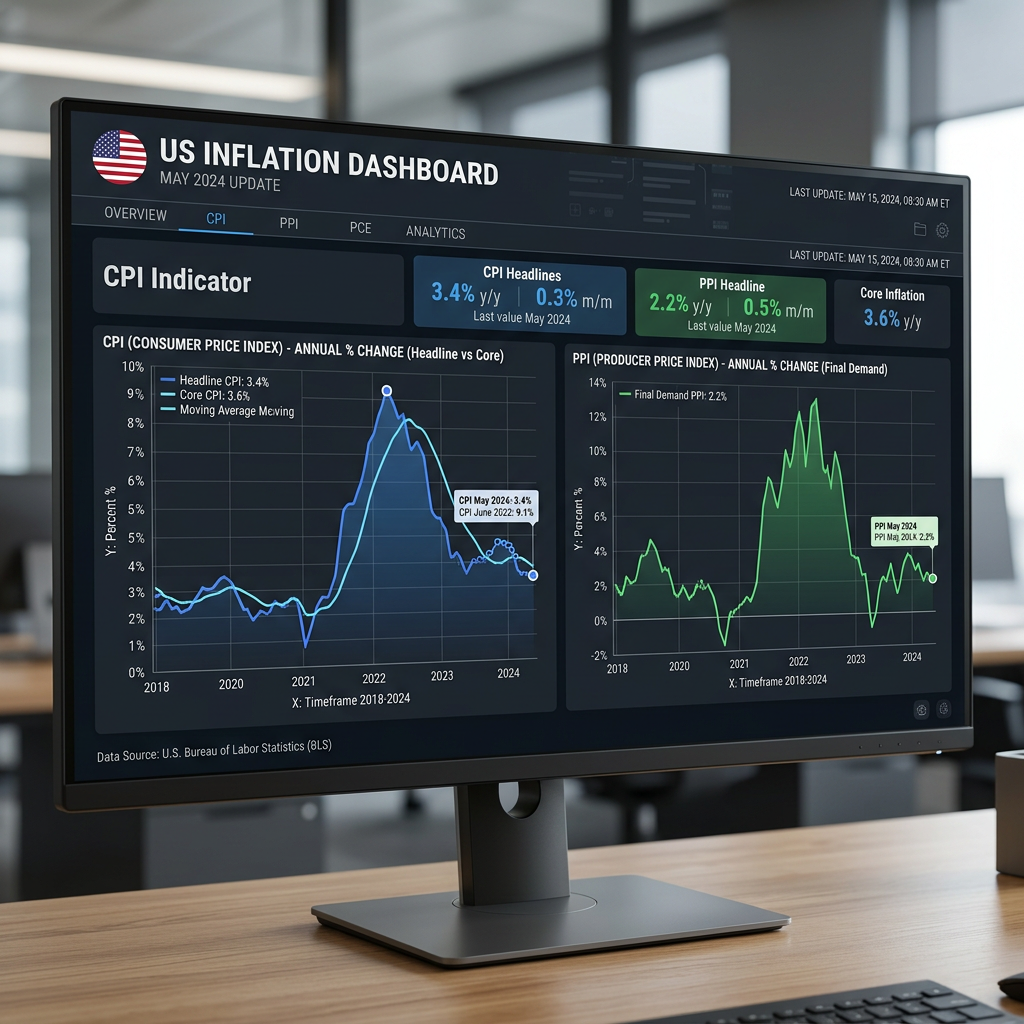
America has now received two major inflation readings in two days, and neither produced evidence of an immediate new inflation surge.
The US Producer Price Index for final demand was unchanged month-on-month in July, compared with a revised 0.1% decline in June. Annual producer inflation slowed to 4.7%, according to the Bureau of Labor Statistics.
That followed Wednesday’s Consumer Price Index report showing headline CPI increasing only 0.1% month-on-month and 3.4% year-on-year.
US inflation dashboard
| Measure | July 2026 | Previous/relevant comparator | Status |
|---|---|---|---|
| Headline CPI, monthly | +0.1% | -0.4% in June | Actual |
| Headline CPI, annual | +3.4% | +3.5% in June | Actual |
| Core CPI, monthly | +0.2% | 0.0% in June | Actual |
| Core CPI, annual | +2.5% | +2.6% previously | Actual |
| Energy CPI, monthly | -1.5% | — | Actual |
| Gasoline CPI, monthly | -2.9% | — | Actual |
| Final-demand PPI, monthly | 0.0% | -0.1% in June | Actual |
| Final-demand PPI, annual | +4.7% | +5.5% in June | Actual |
| Fed target range | 3.50–3.75% | Unchanged in July | Policy |
| Market-implied September hold probability | ~65% | ~60% before PPI | Market pricing |
CPI and PPI figures are official BLS data; the Fed probability is market pricing reported by Reuters and is not a Federal Reserve forecast.
The Run
Thursday’s PPI release strengthened the interpretation that price pressures may be easing at the producer level. Goods prices declined while services increased, leaving the headline index unchanged. BLS reported final-demand services up 0.2%, while final-demand construction prices increased 2.2%.
Wednesday’s CPI had already shown that energy prices fell 1.5% in July despite severe global oil-market disruption. Shelter rose only 0.1% but still accounted for roughly two-thirds of the monthly headline CPI increase. Food increased 0.1%.
Nine145 analysis: the inflation story has shifted from asking whether a large energy shock would immediately spread through the US price system to asking how persistent the remaining underlying inflation will be. July CPI and PPI reduce the pressure for an immediate September move, but a 4.7% annual PPI rate remains too high to describe the inflation problem as resolved.