
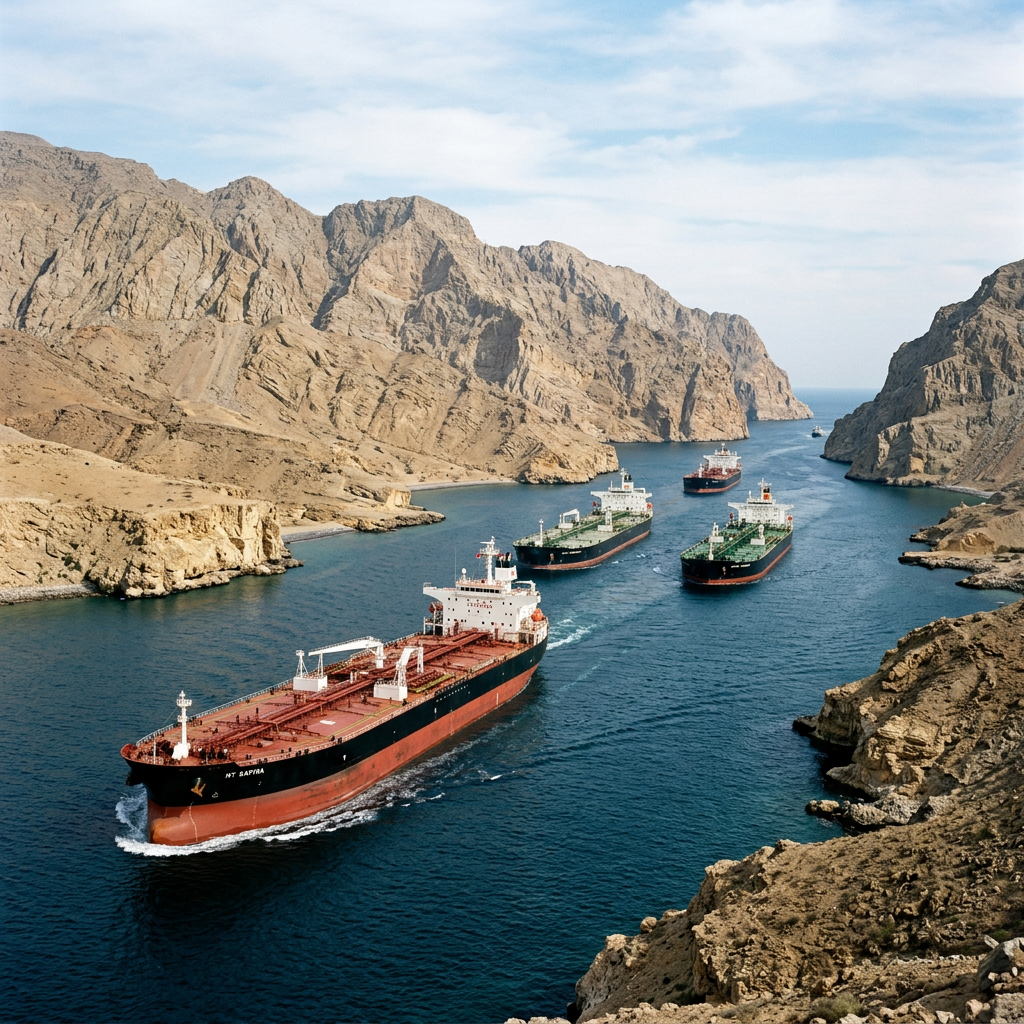
The Strait of Hormuz remains one of the most consequential fault lines in the global economy. Talks aimed at reviving an interim US-Iran peace arrangement have made no substantive progress, while fresh attacks on commercial shipping around the Gulf of Oman and Bab el-Mandeb have renewed concern over the security of both the principal Gulf oil route and one of its major alternatives.
The scale of disruption is now measurable. The US Energy Information Administration estimated in its 11 August Short-Term Energy Outlook that crude oil and petroleum liquids moving through Hormuz averaged just 4.9 million barrels per day in Q2 2026, compared with 21.6 million b/d in Q4 2025, before the conflict. That represents a decline of about 77%.
Hormuz and the global oil shock
| Indicator | Pre-conflict / comparison | Latest EIA figure | Change/status |
|---|---|---|---|
| Hormuz crude + petroleum liquids flows | 21.6m b/d, Q4 2025 | 4.9m b/d, Q2 2026 | About 77% lower |
| Bab el-Mandeb oil flows | 5.4m b/d, Q4 2025 | 8.1m b/d, Q2 2026 | 50% higher as flows were rerouted |
| Estimated production shut-ins | — | 5.5m b/d in July | EIA estimate |
| Global inventory change | — | -4.2m b/d, Q2 | EIA estimate |
| Global inventory forecast | — | -3.8m b/d, Q3 | EIA forecast |
| Brent spot high | — | $105/b on 23 July | EIA-reported peak |
| Q3 Brent forecast | Previous EIA forecast $74/b implied | About $85/b | Raised by $11/b |
| Reuters market snapshot, 12 Aug | $88.91 previous settlement | $88.68/b | Brent futures down 0.26% at cited snapshot |
Important: the EIA flow, shut-in and inventory numbers are estimates/forecasts, not vessel-by-vessel observed totals. The $88.68 figure is a Reuters intraday futures snapshot, not an end-of-day closing price.
The Run
Three developments have converged.
First, talks remain stalled. Iran’s senior security leadership has said Hormuz will remain closed unless Tehran’s conditions are met. Second, a commercial vessel was attacked around the Bab el-Mandeb, while US forces separately acted against a vessel they said was violating the blockade on Iranian ports. Third, the EIA’s new forecast assumes Hormuz traffic remains severely constrained through August, with flows beginning to recover gradually from September.
US maritime authorities continue to classify the Persian Gulf, Strait of Hormuz and Gulf of Oman as high-risk areas for commercial shipping, with an active advisory covering Iranian attacks on commercial vessels.
Nine145 data read
The most striking number is not today’s oil price. It is the collapse from 21.6 million to 4.9 million barrels per day through Hormuz.
The second important number is the increase in Bab el-Mandeb volumes from 5.4 million to 8.1 million b/d. It demonstrates how producers have been rerouting flows. But the latest attack near Bab el-Mandeb illustrates the vulnerability of that workaround: disruption of both chokepoints would constrain the ability to substitute one route for another.
EIA consequently expects depleted inventories and restricted flows to keep oil prices elevated until shipping and production normalise. Its present assumptions suggest trade patterns may take until early 2027 to broadly return towards pre-conflict conditions. That is an EIA scenario assumption, not a guaranteed timetable.