
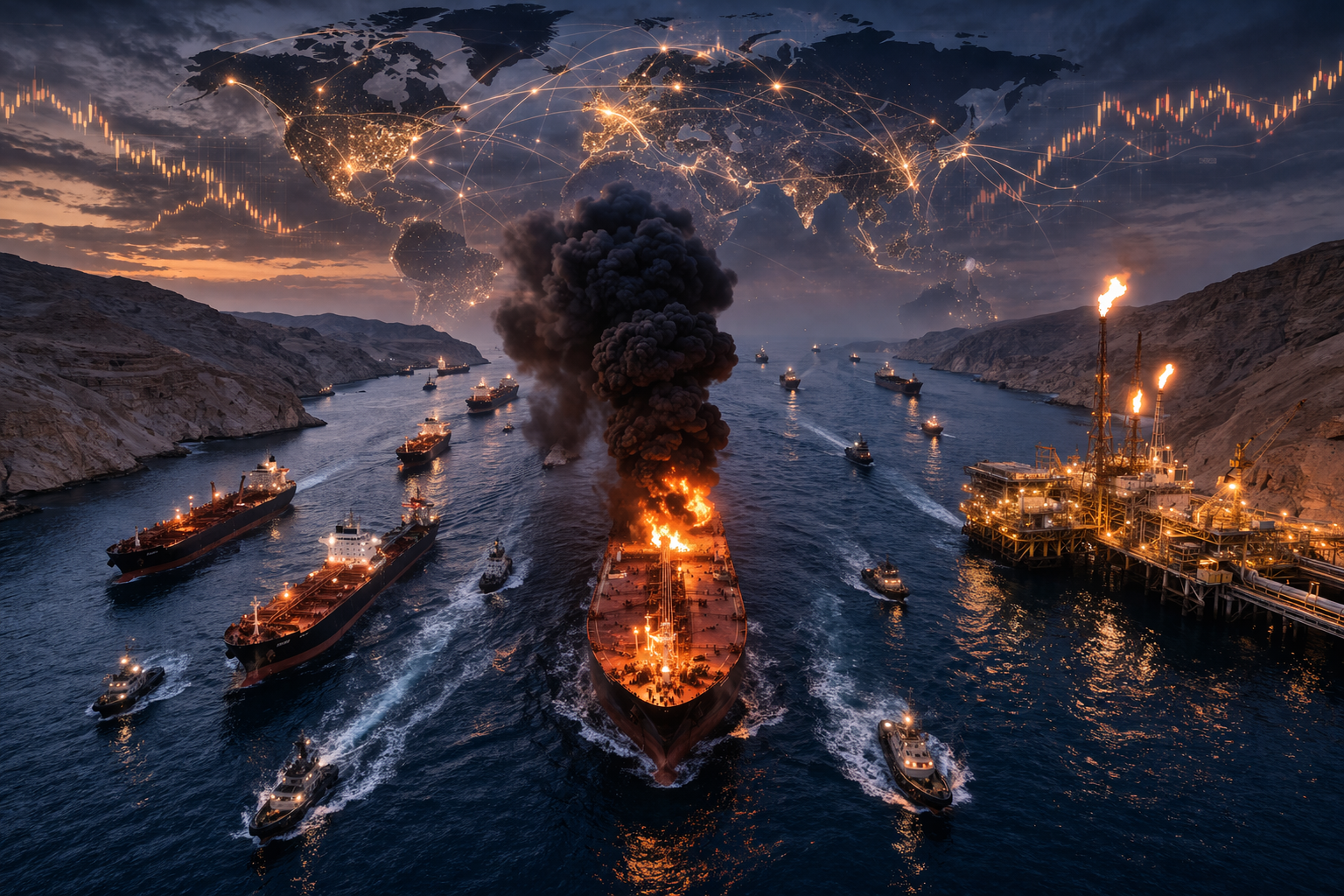
By 1 April 2026, the West Asia crisis had moved well beyond a bilateral exchange of fire and become a regional systems emergency. The verified picture from WHO, EASA, EUROCONTROL, UKMTO, the IMO, the IAEA, the EIA, the World Bank and UN agencies shows a conflict that is simultaneously killing civilians, damaging hospitals and roads, choking air and sea transport, rattling energy markets and forcing governments to prepare for wider economic spillover. This is no longer only a war of strikes and retaliation. It is a war against connectivity: fuel, ports, airspace, desalination, logistics and public health are all under strain.
The heaviest documented human toll remains in Iran and Lebanon. WHO’s latest consolidated regional situation report, covering data up to 24–25 March, recorded 1,825 civilian deaths and 23,061 injuries in Iran, alongside up to 3.2 million displaced people. In Lebanon, WHO recorded 1,094 deaths and 3,119 injuries as of 25 March, while OCHA’s 31 March update said the toll had risen to more than 1,200 killed and nearly 3,700 injured since 2 March. Iraq, though far less devastated than Iran or Lebanon, had still recorded 72 deaths and 346 injuries by 26 March.
The infrastructure picture is equally stark. In Iran, the Ministry of Health, as cited by WHO, reported damage affecting 40 hospitals, 186 health-care facilities and 49 emergency medical posts; seven hospitals were evacuated and 38 ambulances were damaged. In Lebanon, WHO reported that seven bridges linking areas north and south of the Litani had been destroyed, movement had been restricted by damage to roads and bridges, 50 primary health centres and five hospitals had closed, and attacks on health care had risen to 77 verified incidents by 25 March. In Iraq, a Ministry of Defence health facility at Al-Habbaniyah base was hit, and a projectile near Baghdad Teaching Hospital briefly disrupted emergency services. In Gaza, the regional escalation compounded an already broken health system by restricting crossings, forcing fuel rationing and limiting the entry of medical supplies.
The energy story has become one of the clearest markers of regional escalation. WHO reported strikes on oil refineries, depots and energy infrastructure across Gulf states and Iran, and warned that damage to desalination infrastructure in Qeshm Island and Bahrain, plus reported impacts near facilities in Kuwait and the United Arab Emirates, had raised concerns over water safety and access. OCHA separately reported that strikes on 7 March damaged refineries and set four of them on fire in Tehran alone. By 1 April, the IAEA-hosted emergency reporting platform was still logging fresh attacks on industrial sites in Iran that use sealed radioactive sources, including steel production facilities struck on 31 March and 1 April.
The aviation system has also been reshaped. EUROCONTROL said that, at the time of its 31 March publication, all airports in Iraq, Iran and Kuwait were closed to all traffic, while airports in Qatar, Bahrain, Syria and Israel were open with restrictions. It also said Europe–Middle East traffic was running about 59 per cent below pre-crisis levels, after dropping by 80 per cent on 1 March. EASA’s current conflict-zone bulletin covers airspace in Bahrain, Iran, Iraq, Israel, Jordan, Kuwait, Lebanon, Oman, Qatar, the United Arab Emirates and Saudi Arabia, and advises operators not to use most of that airspace at any altitude, with only a narrow exception for part of Saudi and Omani airspace above FL320.
Oil and gas markets reflect the same shock. EIA’s daily price page for 1 April, using the 31 March close, put Brent at US$126.69 a barrel and WTI at US$102.86. On the gas side, EIA’s daily spot table showed US$3.15/MMBtu for Louisiana gas, while its March outlook said reduced LNG flows through the Strait of Hormuz had already pushed gas prices higher in Europe and Asia. The World Bank said crude oil prices rose by nearly 40 per cent between February and March, while the price of LNG shipments to Asia rose by almost two-thirds.
The cost of war is already measurable in several official ledgers, but not yet in one definitive regional bill. By 1 April there was no single authoritative whole-of-war price tag from any official body. What does exist is a set of partial but significant costs: WHO said only 37 per cent of its US$633 million 2026 regional health emergency appeal had been funded; OCHA’s Lebanon Flash Appeal sought US$308.3 million for March to May; UNHCR’s inter-agency flash refugee response plan for Iran sought US$80 million to support 2.8 million people in need; and WHO said the Lebanon health sector alone needed an additional US$37 million under the UN flash appeal. EUROCONTROL also reported jet fuel reaching US$5.1 a gallon on 20 March, 134 per cent above the average from January 2025 to 27 February 2026.
The main theatre remains centred on Iran, Israel and the United States, but the crisis has clearly expanded into proxy and spillover fronts. EASA states that on 28 February the United States and Israel struck targets in Iran and that Iran then carried out retaliatory attacks. Lebanon has become the second major humanitarian front by civilian toll, while Iraq has absorbed strikes, airspace disruption and supply-chain stress. At sea, UKMTO’s Joint Maritime Information Center said the maritime threat environment across the Arabian Gulf, the Strait of Hormuz and the Gulf of Oman remained at critical level, with 21 confirmed incidents since 1 March. In the Red Sea approach, UKMTO also reported Houthi statements indicating intent to close Bab el-Mandeb.
The Trump administration’s line has not been static. The official record shows clear shifts in emphasis. On 25 February, Secretary of State Marco Rubio said talks would be largely focused on the nuclear programme and that progress was hoped for. On 1 March, the White House announced Operation Epic Fury as a campaign to eliminate the imminent threat, destroy ballistic missile forces, degrade proxy networks and cripple Iran’s naval capability. By late March, State Department material was again referring to discussions with what it described as “a new and more reasonable regime” in Iran. That is best understood not as a settled doctrine but as a sequence of diplomatic, military and post-strike political pivots.
On NATO, the authenticated record does not support the claim that Trump had quit the alliance by 1 April. What it does show is a hard campaign for allied burden-sharing and visible tension over Iran. The White House said on 24 February that Trump had secured a commitment for NATO members to raise defence spending to 5 per cent of GDP. On 3 March, NATO Secretary General Mark Rutte explicitly said Trump had not asked NATO to join the US-Israeli campaign in Iran, while noting that some allies were giving enabling support. On 26 March, NATO press conference questioning showed that the Iran war had already become part of the alliance’s political argument, but not an authenticated case of US withdrawal from NATO.
The Strait of Hormuz question is therefore central. The most careful answer on day 33 is this: not formally closed, but functionally constricted enough to disrupt shipping, production and insurance. UKMTO said no recognised authority had declared a formal legal closure, yet described a severely restricted transit environment. JMIC’s 20 March advisory said observed traffic had collapsed to about one vessel a day, against a historical average of about 138 a day. EIA added a crucial nuance: the strait was not physically blocked, but the threat of attack and cancellation of insurance had led most tankers to avoid it. EIA’s March outlook assumes shut-in oil production will peak in early April, mainly in Iraq, with smaller shut-ins in Kuwait, the UAE and Saudi Arabia, before easing if transit resumes. So the right formulation on 1 April is not “closed indefinitely”, but “open in law, choked in practice”.
A final significant detail is the nuclear-risk dimension. WHO’s regional report said strikes had hit Natanz and that it had trained almost 2,000 WHO and UN staff in 13 priority countries for possible radiological exposure scenarios. The IAEA said no abnormal radiation levels had been detected and that there was no evidence of off-site radiological impact from the strikes it had monitored. Yet the same official record also shows repeated hits near or on sensitive nuclear and radiological-linked facilities, including Bushehr and industrial plants using radioactive sources. The absence of a radiological release so far should therefore be read as good news, not as proof that the risk has disappeared.
| Theatre / country | Latest official toll publicly available by 1 April | Verified infrastructure or systems damage | Why it matters |
| Iran | 1,825 dead; 23,061 injured; up to 3.2m displaced | 40 hospitals, 186 health facilities, 49 EMS posts affected; 7 hospitals evacuated; 38 ambulances damaged | Main civilian and health-system burden of the war |
| Lebanon | More than 1,200 dead; nearly 3,700 injured; over 1.1m displaced | Roads and bridges hit, including seven Litani bridges; 50 PHCs and 5 hospitals closed; 77 verified attacks on health care by 25 March | Second-heaviest humanitarian front and a key proxy battlefield |
| Iraq | 72 dead; 346 injured | Airspace closures, transport disruption, damage to a defence health facility, incident near Baghdad Teaching Hospital | Spillover theatre linking Gulf airspace, logistics and militia risk |
| Gaza / West Bank | No new single regional toll in the WHO regional sitrep, but 15 verified attacks on health care in the West Bank since 28 February | Crossings largely closed after 28 February; fuel shortages and restricted supply entry into Gaza | Existing humanitarian crisis worsened by regional escalation |
| Gulf maritime corridor | 21 confirmed maritime incidents since 1 March | Threats to port facilities, bunkering, shipping lanes and offshore energy assets | Converts war risk into trade and energy risk |
| Regional aviation | Airports in Iraq, Iran and Kuwait closed; airports in Qatar, Bahrain, Syria and Israel open with restrictions | Europe–Middle East traffic down roughly 59% versus pre-crisis baseline | War is now reshaping civil aviation and passenger flows |
Table sources: Iran, Lebanon, Iraq and occupied Palestinian territory figures and operational impacts are drawn from WHO Situation Report No. 3 and WHO’s regional overview; Lebanon’s later death and injury update comes from OCHA on 31 March; maritime data are from UKMTO/JMIC; and airport and traffic status are from EUROCONTROL and EASA.
POINTERS
- Day 33 is best understood as a regional systems crisis, not a narrow Iran–Israel exchange. WHO says 21 countries are affected globally, and EASA’s aviation risk map now spans much of the Gulf and Levant.
- Iran has taken the heaviest verified civilian and health-system blow. WHO’s latest consolidated figures show 1,825 deaths, 23,061 injuries and damage across hospitals, EMS posts and ambulances.
- Lebanon is the second major humanitarian front. By 31 March, OCHA said more than 1,200 people had been killed and nearly 3,700 injured, while WHO documented bridge destruction, hospital closures and repeated attacks on health care.
- Energy infrastructure has been directly drawn into the conflict. WHO flagged strikes on refineries, depots, energy assets and desalination systems, and OCHA reported refinery fires in Tehran.
- Air travel across the region has been severely disrupted. EUROCONTROL said all airports in Iraq, Iran and Kuwait were closed at publication time, with other states operating under restrictions.
- Oil and gas markets have repriced the conflict sharply. EIA’s 31 March close showed Brent at US$126.69 a barrel, and the World Bank said LNG cargoes to Asia rose by almost two-thirds between February and March.
- There is still no authoritative single “cost of war” number. What exists instead is a growing stack of official appeals and market costs: US$633m for WHO’s regional health appeal, US$308.3m for Lebanon’s flash appeal and US$80m for Iran’s refugee response plan.
- The Hormuz answer is nuanced. UKMTO says no recognised authority has declared a formal closure, but JMIC and EIA show traffic collapse, insurance retreat and production shut-ins severe enough to make the passage operationally constrained.
- Trump had not quit NATO by 1 April. Official material instead shows continued alliance bargaining, a public drive for higher allied defence spending and NATO’s insistence that the alliance itself was not joining the Iran campaign.
- Washington’s line has shifted over the month. Official US messaging moved from nuclear talks, to a large military campaign, to later talk of discussions with a “new and more reasonable regime”.
- The nuclear-risk file remains open. The IAEA says no abnormal radiation has been detected off-site, but repeated strikes near nuclear and radiological-linked facilities mean the danger has not vanished.