
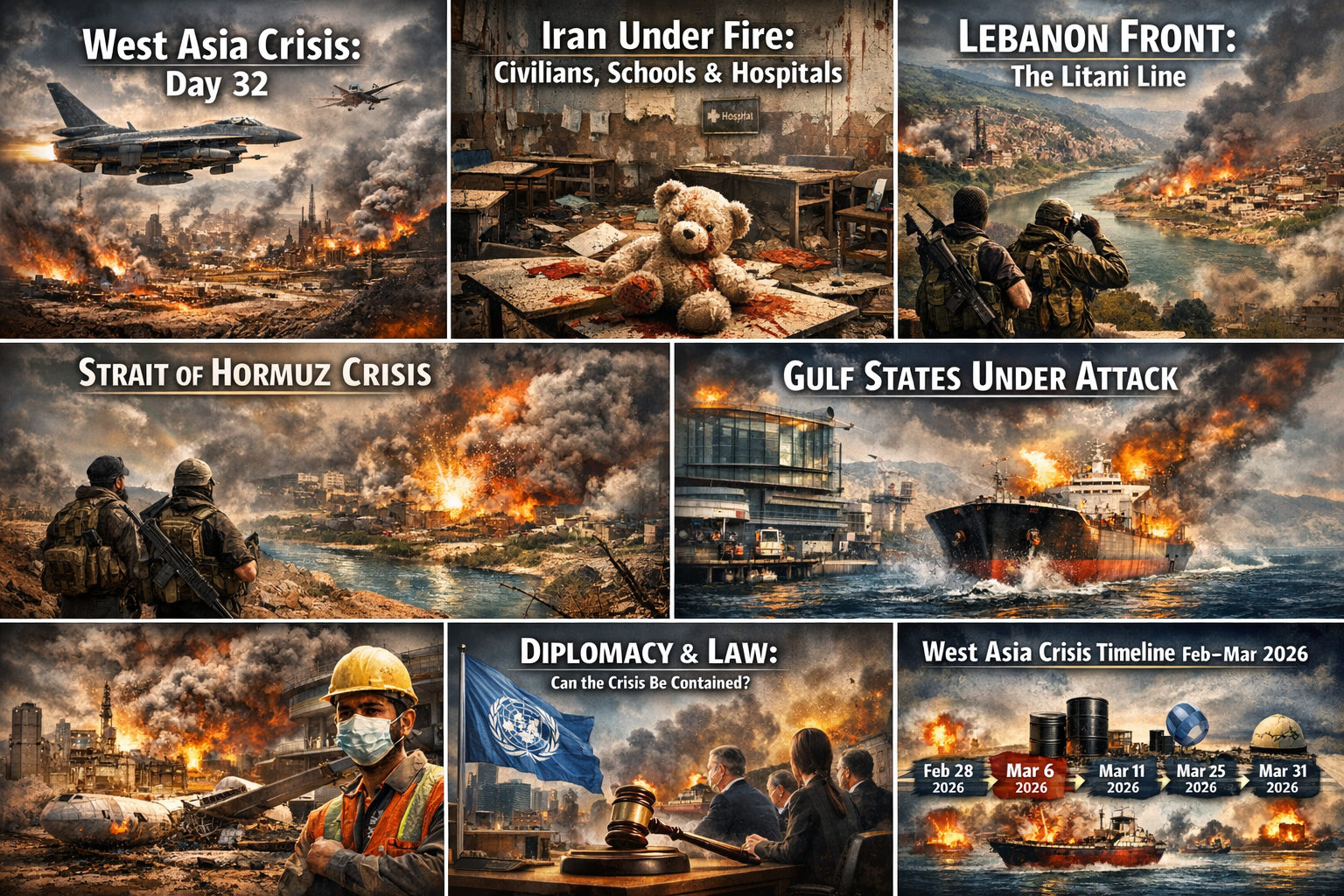
Operation Epic Fury began on 28 February 2026 as a U.S. military campaign against Iran. Official American descriptions present it as a focused war of destruction rather than occupation: break Iranian missile capability, smash missile production, cripple the navy, degrade the wider defence-industrial base, and prevent Tehran from acquiring a nuclear weapon. That is the stable military frame in Pentagon and White House material. But the political frame around it did not remain stable. Donald Trump’s own public line moved repeatedly — from the death of Ayatollah Khamenei as a moment of political rupture, to language of hope for the Iranian people, to a more bounded military mission, to threats against infrastructure, to talk of no troops, winding down and possible deals. That movement is not a side note. It is one of the central facts of the operation’s first month.
The result is that Epic Fury now has two official stories running at once. One is the Pentagon’s story: a large and increasingly deep strike campaign that claims to have hit thousands of targets and badly reduced Iranian missile, drone and naval power. The other is the political story coming from Trump’s own public remarks, which kept changing the implied end-state of the war. If one reads only operational briefings, the campaign looks coherent. If one reads the presidential statements in sequence, it looks more elastic and, at moments, openly contradictory.
What Operation Epic Fury officially says it is
In the Pentagon’s 2 March briefing, Pete Hegseth described the mission in blunt terms: destroy Iranian offensive missiles, destroy missile production, destroy the navy and other security infrastructure, and ensure Iran “will never have nuclear weapons”. The White House’s 12 March release used nearly the same frame, saying the objectives were to obliterate ballistic-missile capacity, annihilate the navy, sever support for proxies and ensure Iran never acquires a nuclear weapon. On 20 March, Trump himself published a Truth Social statement — archived by the American Presidency Project — listing five objectives: degrade missile capability, destroy the defence-industrial base, eliminate the navy and air force, prevent nuclear capability, and protect U.S. regional allies.
That official language matters because it is the narrowest and most defensible version of the campaign. It presents Epic Fury as a coercive military operation with finite goals. It does not, on its face, promise occupation, democratisation or formal regime change. Yet the earliest presidential and White House rhetoric around the campaign went well beyond that narrower frame. That is where the real tension begins.
How the campaign grew over its first month
The operational scale described by the Pentagon is vast. On 10 March, Dan Caine said ballistic-missile attacks had fallen 90 per cent from where they began and one-way attack drones were down 83 per cent, while the United States had already gone after more than 50 Iranian naval ships. On 19 March, Caine said U.S. Central Command was attacking deeper into Iranian territory, had struck more than 120 vessels and 44 mine layers, and was hitting underground storage for coastal-defence missiles. By 31 March, Caine said the campaign had struck more than 11,000 targets in 30 days and had begun the first overland B-52 missions.
These official claims suggest an operation that has broadened from an opening air-and-maritime offensive into a deeper, rolling denial campaign. It is no longer only about launchers and ships near the coast. The 31 March Pentagon update says the focus remains on Iran’s missile, drone and naval production facilities and on its navy itself. That indicates a campaign aimed not merely at immediate suppression but at preventing reconstitution.
Epic Fury by the numbers, as described by official U.S. briefings
| Date | Official claim | What it suggests |
| 2 Mar 2026 | Mission described as destroying missiles, missile production, navy and nuclear path | Opening statement of war aims |
| 10 Mar 2026 | Missile attacks down 90%; one-way drones down 83%; 50+ naval ships hit | Early degradation claimed |
| 19 Mar 2026 | 120+ vessels, including 44 mine layers, attacked; strikes moving deeper inland | Campaign intensifying and broadening |
| 31 Mar 2026 | 11,000+ targets struck; first overland B-52 missions begun | War has shifted into sustained attrition |
The cost beyond the Pentagon frame
The official U.S. narrative is not the whole war. WHO said on 11 March that it had verified 18 attacks on health care in Iran since 28 February, resulting in eight deaths among health workers. On 30 March, UN experts said that, according to Iranian authorities, close to 2,000 civilians had been killed in U.S. and Israeli airstrikes in Iran and more than 3 million people had been temporarily displaced. WHO’s 26 March situation report also described large casualty and displacement numbers, while the IEA said the disruption to Hormuz and attacks on energy infrastructure had become severe enough to justify a new policy tracker and earlier emergency oil measures.
This matters because it changes how one should read official talk of “objectives”. A military campaign can remain fixed on missiles, drones, ships and factories while the region around those targets becomes steadily less governable. Epic Fury may be defined in Washington as a targeted operation, but its effects by late March were already humanitarian, economic and strategic all at once. ESCWA warned on 19 March that if the conflict continued for a month, losses to Arab economic output could reach nearly $150 billion.
The missing story: Trump’s shifting public line
This is the part that cannot be ignored. The White House on 12 March said Epic Fury’s objectives had remained “unchanged, unambiguous, and consistent” since the operation began. But Trump’s own public rhetoric does not read that way when laid out chronologically. The military mission may have stayed fairly steady. The presidential meaning attached to it did not.
28 February: Khamenei’s death as a political opening
On 28 February, Trump did not speak merely as a commander announcing a strike. In his statement on Khamenei’s death, he cast the moment as justice and as a major opening for Iran itself. He said it was the “single greatest chance” for Iranians to reclaim their country and urged internal actors to move. The political implication was unmistakable: this sounded like more than missile suppression. It sounded like the top of the Iranian order had been broken and that something larger could now follow.
1 March: hope for the Iranian public
The next day, the White House widened that political atmosphere rather than cooling it. Its 1 March release called Epic Fury a campaign to crush the Iranian regime and end the nuclear threat, but it also highlighted Iranian-American reactions describing a “new dawn of hope” and the possibility that “the people of Iran” might be freed. That kept the war wrapped in liberation language, not just military language.
2 March to 12 March: a tighter military frame returns
Very quickly, however, the language narrowed. The Pentagon on 2 March and the White House on 12 March both stressed fixed operational goals: missiles, missile production, navy, proxies, nuclear denial. The political register of public liberation and internal Iranian opening faded from the official foreground. That did not erase the earlier rhetoric, but it did create a visible turn from political rupture to military definition.
13 March: Kharg Island and coercive restraint
On 13 March, Trump’s statement on Kharg Island introduced another shift. He said U.S. forces had obliterated every military target there but that he had chosen not to wipe out the island’s oil infrastructure. The message was not peace. It was leverage. He was telling Tehran and the wider world that America was holding back a larger economic strike and could still escalate if it wished.
17 March: from political rupture to “a little excursion”
By 17 March, Trump was speaking in a strikingly different register. In pool remarks, he called the Iran war “a little excursion”, said it would be over “in a couple of weeks”, and described Iran as largely finished as a military problem. In the same round of remarks he said the navy had been wiped out, the air force had gone next, and the United States could take out Iran’s electric capacity “in one hour”. This was no longer the rhetoric of Iranian political renewal. It was the rhetoric of quick overmatch, compressed timelines and infrastructure threat.
19 March: no troops, fast ending, no appetite for occupation
On 19 March, Trump said plainly that he was not sending troops to Iran. He also said the war would be over soon and that Iran’s capabilities had been largely obliterated. This was an important correction in tone. Whatever earlier remarks had implied politically, Trump was now clearly distancing himself from the idea of a ground commitment or prolonged U.S. ownership of Iran’s future.
20 March: a narrower, almost checklist-style end-state
Trump’s 20 March statement is one of the most revealing documents in the sequence. It reads almost like an audit list: missiles, industrial base, navy and air force, nuclear denial, allied protection. It also says the United States is getting very close to its objectives and suggests that other countries using the Strait of Hormuz should guard and police it, with the U.S. helping only if asked. This is a notably narrower and more transactional end-state than the atmosphere of 28 February and 1 March.
23 March: back to talks, but with bombing still as leverage
On 23 March, the line shifted again. Pool reports record that Trump said Iran had agreed not to have a nuclear weapon. In the same sequence of remarks, he said there had been “very, very strong talks”, that major points of agreement existed, and that if the process failed, the United States would “keep bombing”. That is the clearest pivot from destructive triumphalism to coercive deal-making. The war was being presented not as a march to a final battlefield outcome, but as pressure that might yet produce a negotiated one.
31 March: the latest official frame is operational, not transformational
By 31 March, the most current official update came not from Trump in a grand political statement, but from the Pentagon. Caine’s remarks that day stayed on targets, air superiority, B-52 missions and production facilities. That does not prove Trump had abandoned broader political hopes. But it does suggest that, by month’s end, the administration’s most concrete public line had settled back into operational attrition rather than regime-overturn rhetoric. That is an inference from the official record, and it is a reasonable one.
Trump’s shifting script, 28 February to 31 March
| Date | Main public register | One-line reading |
| 28 Feb | Khamenei dead; Iran has a chance to reclaim itself | Decapitation presented as political opening |
| 1 Mar | Iranian public hope foregrounded by White House | War wrapped in liberation language |
| 2–12 Mar | Mission restated around missiles, navy, nuclear denial | Military frame reasserted |
| 13 Mar | Kharg struck, oil spared for now | Escalation held in reserve as leverage |
| 17 Mar | “Little excursion”; quick end promised; electricity threatened | Triumphalist compression and coercion |
| 19 Mar | No troops; war ending soon | No occupation, no ground-war image |
| 20 Mar | Objective checklist; others should police Hormuz | Narrower, burden-sharing end-state |
| 23 Mar | Strong talks; no-nuclear deal possible; bombing still threatened | Pivot to coercive diplomacy |
| 31 Mar | Pentagon update stays operational | Campaign publicly stabilises around target degradation |
What these shifts tell us
The simplest conclusion is not that Trump had no objective. It is that he kept several possible objectives alive at once. One audience could hear political rupture inside Iran. Another could hear a limited military campaign. Another could hear that there would be no American ground war. Another could hear that talks might still produce a deal. This kind of ambiguity can be tactically useful. It can also make strategic reading far more difficult, because the war’s declared destination appears to move depending on the day and the audience.
That is why the charge of “flip-flops” cannot be dismissed as merely partisan rhetoric. There really was a visible sequence of changes: from Khamenei as political break-point, to hope for Iranians, to a bounded military mission, to infrastructure coercion, to no troops, to winding down, to talks under threat of renewed bombing. Whether one sees that as flexibility or inconsistency depends on one’s politics. But the movement itself is present in the record.
Where Operation Epic Fury stood on 31 March
As of 31 March, the operation still looked unfinished. The Pentagon said more than 11,000 targets had been struck and that pressure remained focused on missile, drone and naval production. Yet WHO, OHCHR, IEA and ESCWA material shows a region already carrying heavy civilian, health, energy and economic damage. So the most accurate description of Epic Fury at month’s end is this: militarily expansive, politically elastic, regionally destabilising, and still short of a clearly settled end-state.