
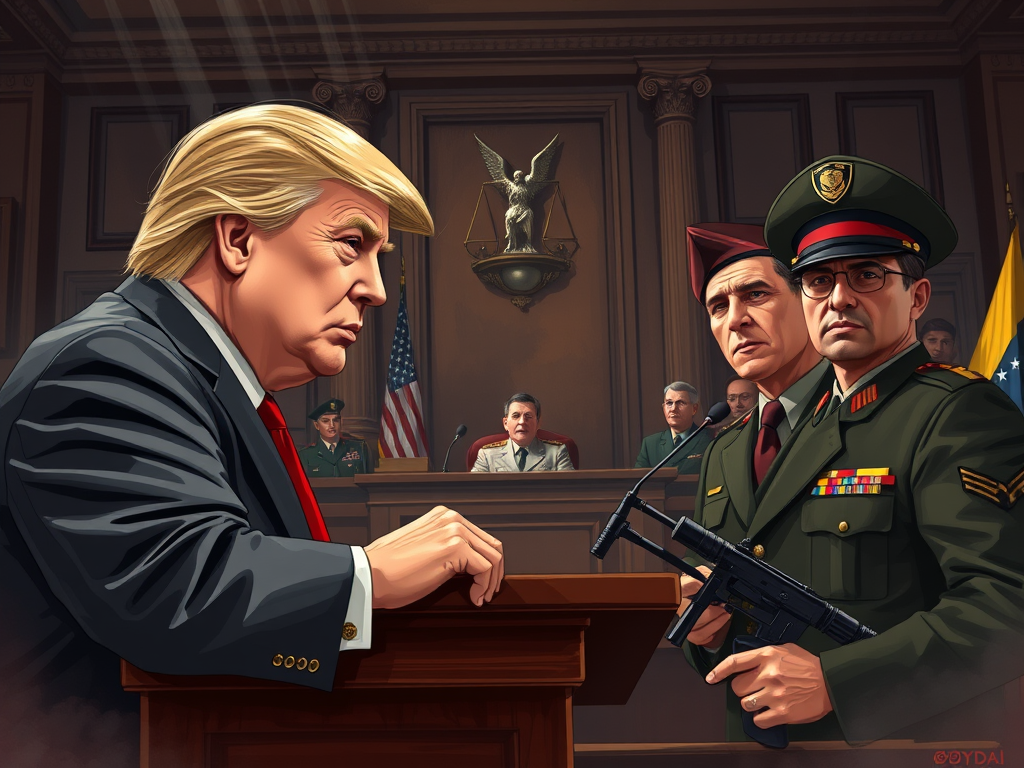
Operation Absolute Resolve sits in a narrow corridor where criminal process, military force, and sovereignty constraints collide. The legal debate is not peripheral. It is central to how the operation will be judged, especially if the case proceeds in US federal court.
Indictments and the “Narco-Terror” Construction
US authorities pointed to a superseding federal indictment naming Maduro, Flores, and other senior figures.
The claim is not simply that trafficking occurred. It is that elements of state power were used to enable it, moving the allegation from criminality to governance.
Core Allegations Referenced by US Authorities
| Count | Charge Heading | Allegation Summary (as characterised by US filings) | Typical Legal Exposure |
| 1 | Narco-terror conspiracy | Alleged coordination with armed groups to push cocaine into the US | Severe mandatory minimums; potential life |
| 2 | Cocaine importation conspiracy | Alleged planning to move multi-ton quantities into US territory | Long custodial terms |
| 3 | Machinegun possession in furtherance | Alleged possession/use of military-grade weapons to protect trafficking | Enhanced penalties |
| 4 | Weapons acquisition conspiracy | Alleged intent to obtain destructive devices for enterprise protection | Heavy sentencing range |
US statements also described Venezuela as operating as a “narco-state”, with an asserted flow capacity of up to 250 tonnes of cocaine annually.
The designation of the alleged network as an FTO was central to converting a counternarcotics narrative into an anti-terror framing.
That conversion carries consequences for permissible tools, interagency posture, and the public case presented for the use of force.
Presidential Authority vs Congressional Control
US officials cited Article II commander-in-chief authority as an anchor for the operation.
They described the mission as necessary to protect personnel executing an arrest warrant.
That approach effectively treats a foreign-soil seizure as a protective or defensive action attached to criminal process.
Critics countered that the act entering a sovereign capital, striking military infrastructure, and detaining a sitting head of state resembles war-making in practice regardless of label.
The War Powers Resolution and the constitutional allocation of war-declaring authority to Congress remain key flashpoints in that critique.
The absence of a clear congressional authorisation vote is likely to keep the domestic dispute active.
International Law: Prohibition on Force and the Immunity Problem
Internationally, the operation faces scrutiny under UN Charter rules, particularly the prohibition on the use of force against another state’s territorial integrity and political independence.
Exceptions exist, but the public record as described does not cleanly map to conventional self-defence or Security Council authorisation pathways.
A second line concerns head of state immunity. Serving heads of state are typically treated as immune from foreign criminal jurisdiction under customary international law.
US policy attempted to route around this by prior derecognition of Maduro and recognition of an alternative leadership claim.
Opponents argue that de facto control remains relevant to immunity analysis and precedent-setting risk.
A further reported element was a classification approach. Casting cartel actors as “unlawful combatants” and treating the US as engaged in an “armed conflict” with such networks.
That move attempts to import LOAC concepts into a space usually handled through law enforcement.