
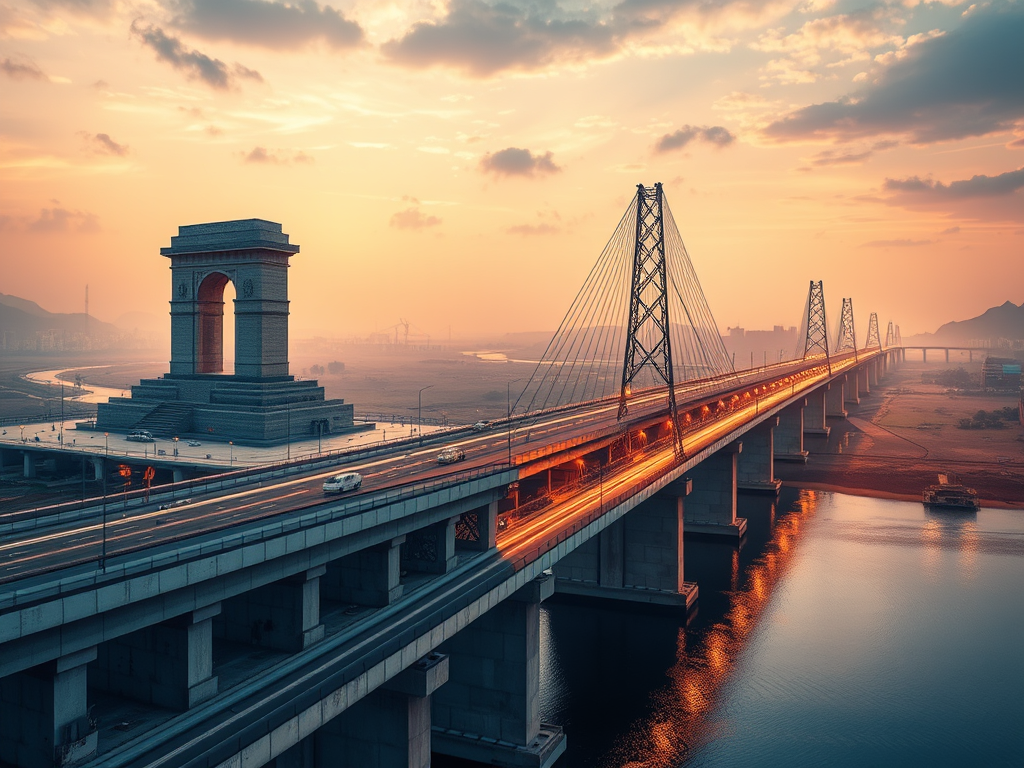
BUILDING THE BACKBONE
India’s industrial resurgence is being powered by a once‑in‑a‑generation push to deliver world‑class infrastructure. Flagship schemes such as Bharatmala, Sagarmala, PM Gati Shakti and the National Industrial Corridor Development Programme (NICDP) now form a single, integrated blueprint: lubricating supply chains, shrinking travel times and opening new manufacturing frontiers exactly where Make in India needs them most.


1. Icons that Signal Engineering Ambition
| Project | Distinction |
| Statue of Unity | World’s tallest statue |
| Atal Tunnel | World’s longest highway tunnel |
| Chenab Bridge | World’s highest railway bridge |
| Zojila Tunnel | Asia’s longest tunnel |
These signature structures are more than symbols; they demonstrate hard‑won expertise in geotechnics, metallurgy and high‑altitude construction—competencies that cascade into everyday highway, rail and metro projects nationwide.
2. A ‘Grand Necklace’ of Smart, Industrial Cities
Cabinet approval (28 August 2024) unlocked ₹28,602 crore for 12 green‑field industrial nodes under NICDP, strung along six economic corridors:
| Industrial City (Node) | State |
| Khurpia | Uttarakhand |
| Rajpura–Patiala | Punjab |
| Dighi | Maharashtra |
| Palakkad | Kerala |
| Agra & Prayagraj | Uttar Pradesh |
| Gaya | Bihar |
| Zaheerabad | Telangana |
| Orvakal & Kopparthy | Andhra Pradesh |
| Jodhpur–Pali | Rajasthan |
Smart utilities, plug‑and‑play plots and multimodal freight links position these hubs to absorb investment spilling over from saturated clusters.
3. National Highways: 60 % Longer, Vastly Faster
Figure 1 (above) captures the leap from 0.91 lakh km (2014) to 1.46 lakh km (2024).
Under Bharatmala, progress to 28 Feb 2025 is compelling:
| Metric | Status |
| Corridor length sanctioned | 34,800 km |
| Projects awarded | 26,425 km |
| Completed length | 19,826 km |
| Spend to date | ₹4.93 lakh crore |
| Greenfield high‑speed corridors | 4,610 km of 6,669 km awarded |
4. Ports & Waterways: Sagarmala’s Momentum
| Item | Figure (19 Mar 2025) |
| Projects identified | 839 |
| Indicative outlay | ₹5.79 lakh crore |
| Projects completed | 272 |
| Investment realised | ₹1.41 lakh crore |
Deeper draught berths, coastal economic zones and Ro‑Pax routes are already shaving logistics costs for bulk commodities and container traffic alike.
5. Urban Rail: Quadrupling in a Decade
Figure 2 shows metro track exploding from 248 km to 1,011 km by March 2025, spanning 20+ cities. Add the country’s first Namo Bharat RRTS corridor and the horizon shifts again from city‑scale to region‑scale commuting.
6. Railways: Speed, Comfort and Modern Stations
| Initiative | Key 2025 Milestones |
| Vande Bharat | 136 trains in service; first sleeper set cleared at 180 km/h |
| Amrit Bharat Stations | 1,337 stations earmarked for complete makeover |
The domestic design and build of Vande Bharat rolling stock embodies the Make in India ethos—advanced, export‑ready and cost‑competitive.
7. Airports: Connecting the Hinterland
Figure 3 underlines the jump from 74 operational airports (2014) to 159 (March 2025). Break‑out reforms—UDAN subsidies, low‑cost terminal designs, and a surge in flying‑training organisations (38 FTOs, 57 bases)—mean capacity is rising just as demand eclipses 5 lakh domestic passengers per day.
8. Integrated Logistics via PM Gati Shakti
A geospatial digital spine now forces 16 infrastructure ministries to co‑ordinate before breaking ground. By 13 March 2025 the Network Planning Group had vetted 115 highway projects (13,500 km, ₹6.38 lakh crore), slashing tardy land acquisition and utility shifting.
9. At a Glance – The Decade’s Big Numbers
| Indicator | 2014 | 2024/25 | Growth |
| National highways (lakh km) | 0.91 | 1.46 | 60% |
| Metro rail (km) | 248 | 1,011 | 4× |
| Operational airports | 74 | 159 | 2× |
| Sagarmala projects (₹ lakh cr) | – | 5.79 | New |
| Bharatmala spend (₹ lakh cr) | – | 4.93 | New |
10. The Road Ahead
India’s infrastructure drive is no longer a string of isolated projects; it is an ecosystem designed to multiply the returns of Make in India. Hinterland factories are gaining the same proximity to ports and airports that coastal zones once monopolised, while seamless digital planning keeps cost and carbon footprints in check. As capital expenditure stays the course, the decade to 2030 could see India graduate from engineering marvels to a truly engineered economy—one where efficient movement of ideas, goods and people becomes the new comparative advantage.