
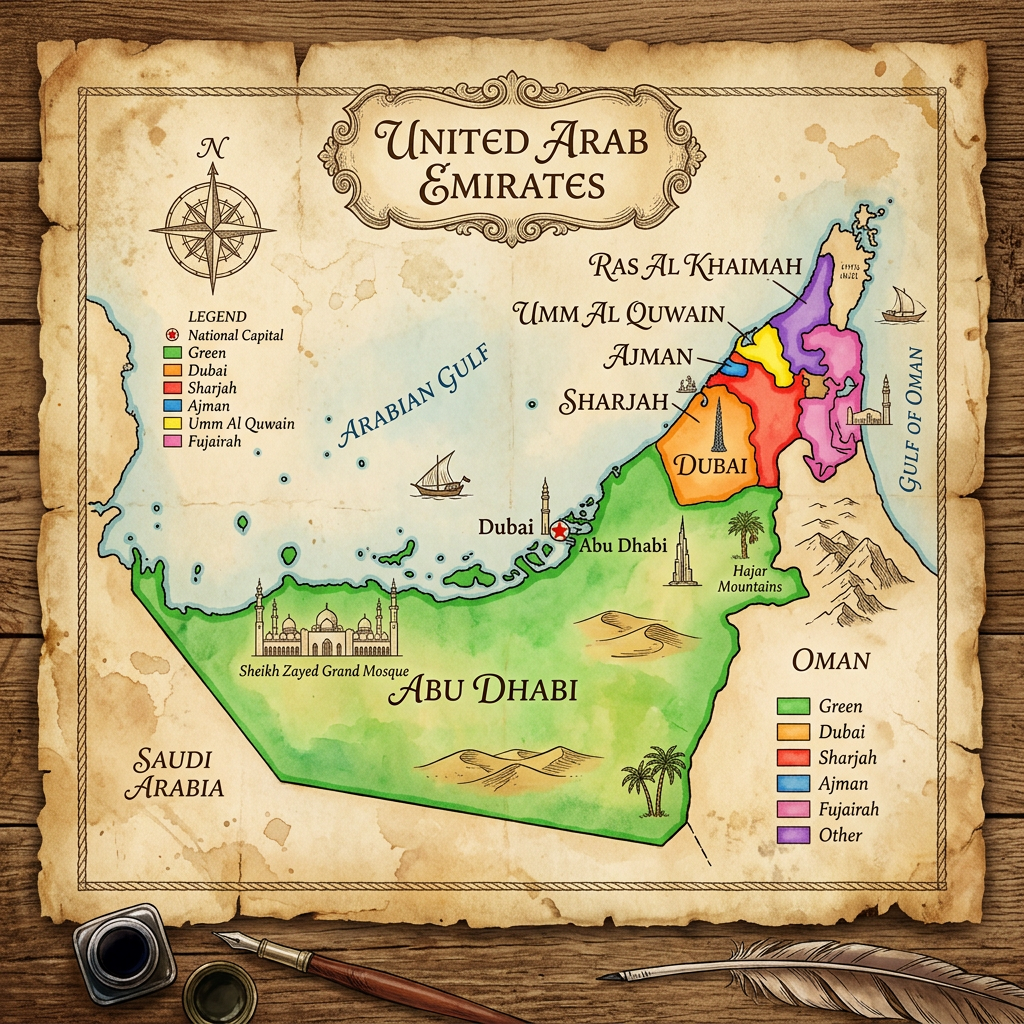
- Constitutional federation of seven emirates
- Abu Dhabi + Dubai + Sharjah + Ajman + Umm al-Quwain + Ras al-Khaimahen + Fujairah
- Along the eastern coast of the Arabian Peninsula
- Emirate of Abu Dhabi: largest emirate (covers over 3/4th of the Federation’s total land area) – country’s oil hub
- Emirate of Dubai: seen as UAE’s international hub – a financial centre with hundreds of MNCs having establishments there – a global travel and tourism hub
- Capital – Abu Dhabi
- Official language – Arabic
- Official religion – Islam
- Official currency – the Arab Emirati Dirham (AED) – 1 USD = AED 3.6725
- UAE’s passport – 1st position globally
- Country’s area: approximately 83,600 sq km
- Country is 4 hours ahead of GMT
- Total population: (nationals and expatriate residents) – 9,282,410 in 2020
- Literacy rate (15+ population): 98% (2022)
- Fiscal Year: 1 January to 31 December
Presidents so far
- Late Sheikh Zayed bin Sultan Al Nahyan: founding father – 1st president – from 2 December 1971 (when UAE was established) to 2004 (till his death)
- Late Sheikh Khalifa bin Zayed Al Nahyan: 2nd president – 2004 to 13 May 2022 (till his death)
- Sheikh Mohamed bin Zayed Al Nahyan: 3rd president – since 14 May 2022
Country’s Oil Reserve
(OAPEC’s Annual Statistical Report 2024 + US Department of Commerce)
- Comes among world’s 10 largest oil producers
- Ranked 6th in the world – 113 billion barrels – proven oil reserves – 96% in the Emirate of Abu Dhabi
- Daily average production – 3.2 million barrels of petroleum and liquids – OPEC’s 4th biggest crude oil producer
- Daily export of crude oil – 2.88 millions of barrels per day (for 2025) – OPEC’s third biggest oil exporter behind Saudi Arabia (6.43 mbpd) and Iraq (3.25 mbpd) – OPEC Annual Statistical Bulletin 2026
- Natural gas – estimated to hold 7th largest proven reserve – at over 215 trillion cubic feet (the U.S. Energy Information Agency)
- An oil and gas export based economy – output of oil and gas industry equals to 30% of the GDP of the country and 13% of exports
Leaving OPEC/OPEC+
- 1967: Emirate of Abu Dhabi joined OPEC
- 1971: OPEC membership continued with formation of UAE
- 28 April 2026: UAE announced to leave OPEC and OPEC+ (effective 1st May 2026)
- Decision taken in the interest of national growth prospects and sovereign responsibility with a sustained growth expected in global energy demands in years ahead
- ADNOC: UAE’s state owned oil company and big global player – $55 billion of investment between 2026 and 2028 – to make UAE a bigger and independent producer in the global energy market