
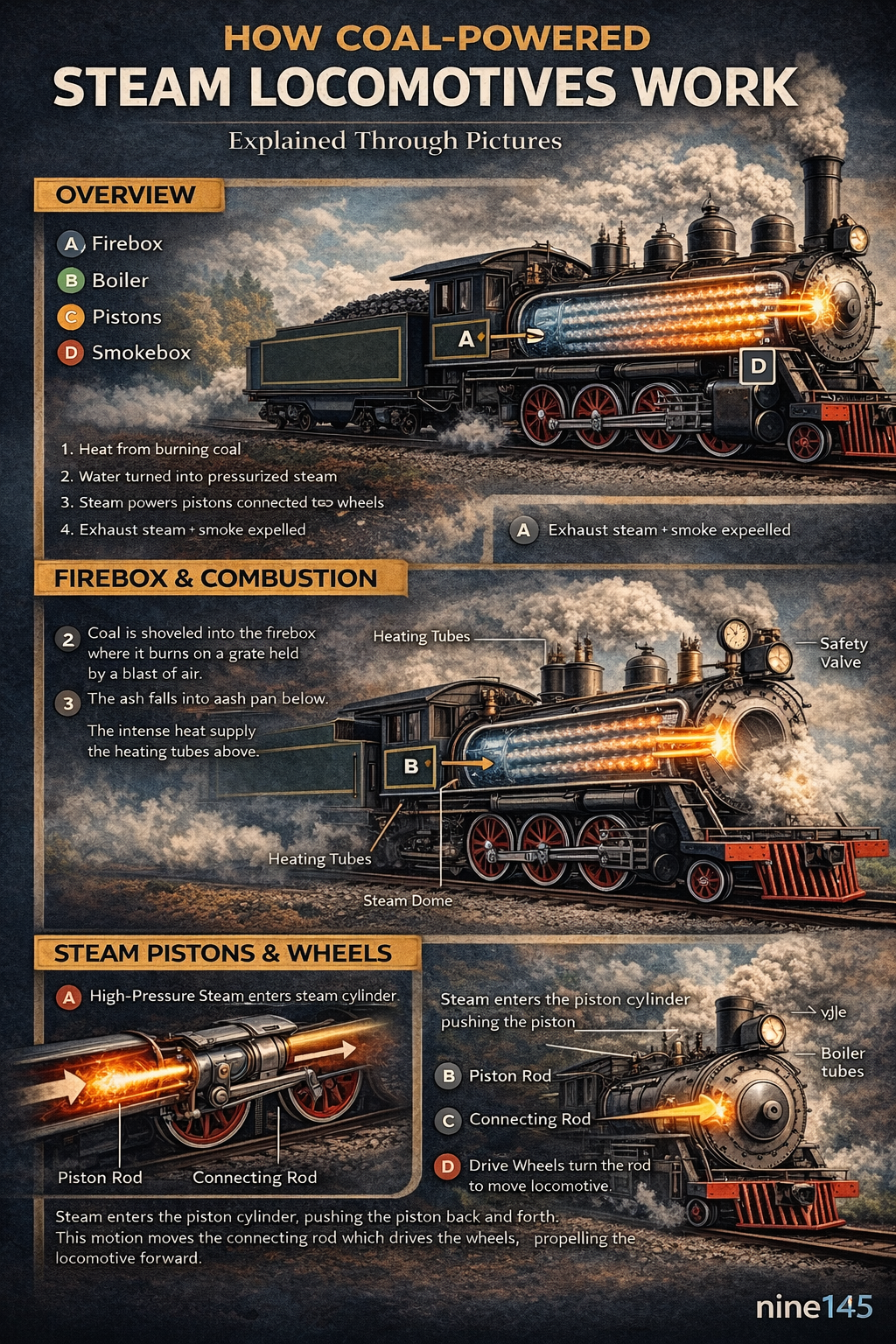
1. Firebox – Burning the Coal
- Coal is manually (or mechanically) fed into the firebox.
- It burns at very high temperatures, producing intense heat.
- This heat is the starting point of the entire engine process.
2. Boiler – Turning Water into Steam
- The fire heats water stored in a large tank called the boiler.
- Hot gases pass through tubes surrounded by water.
- Water converts into high-pressure steam.
3. Steam Pressure Builds Up
- Steam accumulates under pressure inside the boiler.
- Pressure is controlled using valves to avoid explosion.
- This stored energy is what powers the train.
4. Pistons Move the Wheels
- Steam is directed into cylinders.
- It pushes pistons back and forth.
- Pistons are connected to rods that turn the wheels.
5. Exhaust Steam Leaves the Chimney
- After doing its work, steam is released through the chimney.
- This creates the classic “chuff-chuff” sound.
- It also helps draw more air into the fire, keeping combustion going.
The Energy Flow
Coal burns → heats water → creates steam → steam pushes pistons → pistons turn wheels → train moves
A coal engine is essentially a heat engine—it converts thermal energy (from coal) into mechanical energy (motion of wheels) using steam as the medium.
