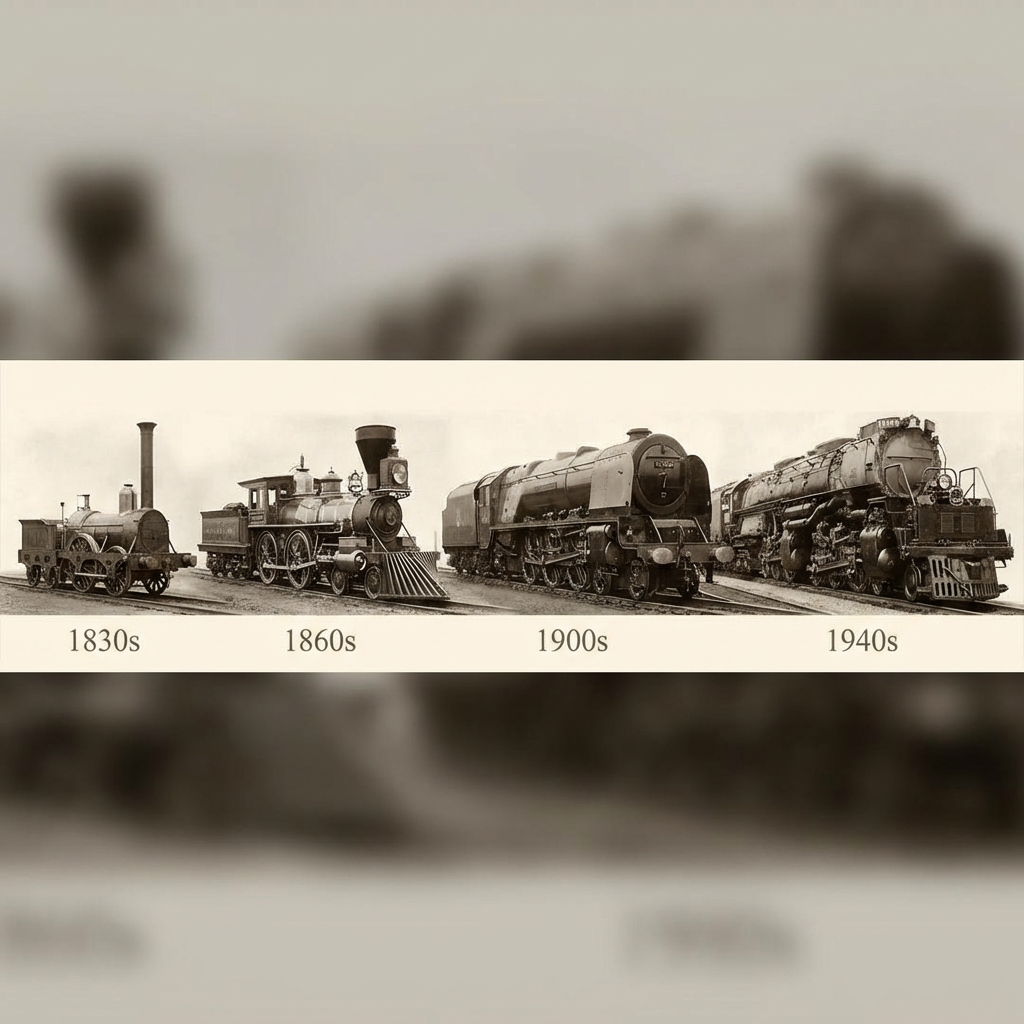
Early Development (Pre-Industrial to First Engines)
- 1712 – England
Thomas Newcomen builds the first practical steam engine (stationary, used in mines).
- 1769 – Scotland
James Watt improves efficiency → foundation for locomotives.
- 1804 – Wales (UK)
Richard Trevithick runs first steam locomotive on rails
- Capacity: ~10 tons iron + ~70 passengers (experimental)
- Speed: ~8 km/h
Commercial Breakthrough (1825–1850)
- 1825 – England
Stockton and Darlington Railway opening
- First public railway using steam locomotives
- Haul: coal + passengers
- 1829 – England
Stephenson’s Rocket
- Speed: ~48 km/h
- Established modern locomotive design
- 1830 – England
Liverpool and Manchester Railway opening
- First fully operational inter-city railway
Global Expansion (1850–1910)
- 1853 – India
First passenger train in India
- 34 km (Bombay–Thane)
- 3 locomotives, ~400 passengers
- 1869 – USA
First Transcontinental Railroad completion
- By 1900
- Steam locomotives dominate Europe, USA, India, Russia, Japan
- Typical freight capacity: 500–2,000 tons
- Speed range: 40–100 km/h
Peak Era (1910–1945)4
- 1920s–1940s = Golden Age of Steam
- Example:
Union Pacific Big Boy (USA)
- Power: ~6,300 hp
- Freight: up to 3,600 tons
- One of the largest ever built
- Global fleet:
- Estimated >1 million steam locomotives produced worldwide (19th–20th century cumulative)
Decline Phase (Post-World War II)
- 1950s–1970s
- Diesel and electric engines replace steam
- Reasons:
- Lower maintenance
- Higher efficiency
- Less manpower
🌍 Country-wise Last Regular Use (Major Systems)
| Country | Last Regular Steam Use | Notes |
| UK | 1968 | End of British Rail steam |
| USA | 1960 (major), some till 1969 | Fully dieselised early |
| India | 1985 (mainline), 1995 (last WP service) | Indian Railways phased out steam |
| China | ~2005 (industrial lines till ~2010) | Last major user globally |
| Russia (USSR) | ~1975 | Shifted to diesel/electric |
| Japan | 1975 | Complete transition |
| South Africa | ~1990s (some lines later) | Narrow gauge lasted longer |
Present Status (2020s)
- Steam locomotives are now used for:
- Heritage tourism
- Mountain railways
- Special excursions
- Examples:
- Darjeeling Himalayan Railway
- Nilgiri Mountain Railway
⚙️ Quick Technical Snapshot
| Parameter | Typical Range |
| Fuel | Coal |
| Power | 500 hp → 6,000+ hp |
| Speed | 30–120 km/h |
| Freight capacity | 500–3,500 tons |
| Crew | 2–3 (driver, fireman, assistant) |
Bottom Line (One-Line Evolution)
1712 (steam idea) → 1804 (first locomotive) → 1825–1830 (railway revolution) → 1900–1940 (global dominance) → 1950–1985 (decline) → today (heritage use)
Related