
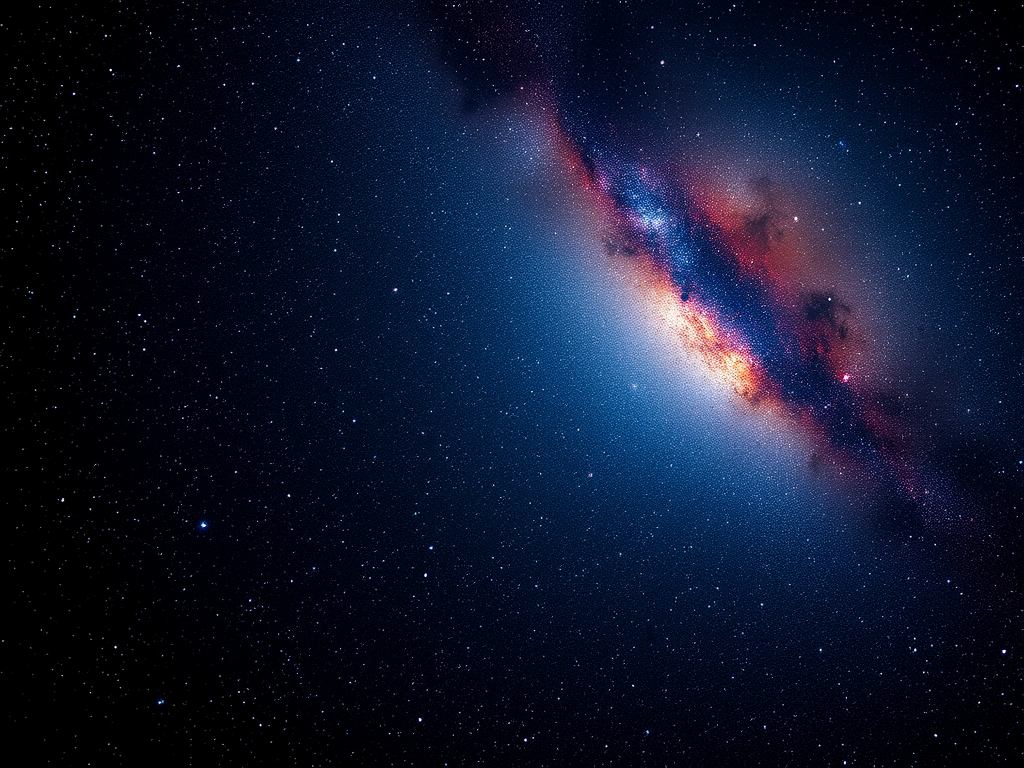
Across the past thirty years cosmology has shed its toga of speculation and put on a lab-coat. Between mountaintop mirrors, orbiting observatories and statistical acrobatics, astronomers can now produce something like an inventory of the cosmos, from the eight worlds that circle our Sun to the two-trillion-strong archipelago of galaxies that forms the observable universe. The numbers feel counter-intuitive—sometimes because they are so large, sometimes because they are surprisingly small—and that tension is precisely where today’s “precision astronomy” lives.
Stars: From a Hundred Billion to a Septillion
Inside the Milky Way, dust skeins and inconvenient geometry prevent a literal head-count, but models that match brightness, mass and rotation converge on 100 – 400 billion stars. ESA public documents prefer the neat phrase “one hundred thousand million.” Extrapolate to the whole observable universe and the arithmetic explodes: 10²²–10²⁴ stars—up to one septillion, a figure commonly wheeled out by NASA for public outreach. That trounces the fabled ‘grains of sand’ comparison.
Sun-Like Rarities and a Dwarf Majority
Only 7.6 percent of those stars resemble the Sun (G-type main-sequence). In contrast, red dwarfs claim roughly three-quarters of the stellar electorate; a 2016 Hubble-based model by Leiden students pegged their Milky Way population at ≈ 58 billion. Brown dwarfs—“failed stars”—were once thought outliers but a 2017 reassessment suggested 25–100 billion lurk unseen, about one for every two normal stars.
Planets and their Moons
Confirmed exoplanets are racing towards six thousand—NASA logs 5 800+, the Extrasolar Planets Encyclopaedia lists 5 943. Add detection biases and Kepler statistics and you land on hundreds of billions of planets strewn through the Milky Way alone—roughly one per star.
Moons are almost as eye-watering. Official tallies give 418 orbiting the eight major planets, plus 507 round dwarf worlds and asteroids, pushing the known count above 900. Dynamical estimates suggest the real figure could flirt with 10 000 when every pebble-moon is tracked down.
Galaxies: From Deep-Field Glimmers to Two Trillion Islands
Hubble’s iconic Deep Field once implied 100–200 billion galaxies. Updated 3-D reconstructions that compensate for dwarfs too dim for HST force a ten-fold rewrite: ≈ 2 trillion galaxies lie within the 46-billion-light-year particle horizon, meaning fully 90 percent of cosmic cities are presently invisible to our finest cameras.
Compact Heavyweights
Pulsar surveys find ≈ 3 200 neutron stars, yet supernova bookkeeping argues for 10⁸–10⁹ aged, radio-quiet cousins. Black-hole hunting in X-ray binaries has netted only ≈ 50 stellar-mass holes, but population synthesis says the Milky Way hosts about 100 million. Above this lurk supermassive black holes at the centre of almost every large galaxy; Sagittarius A* in our own bulge weighs 4 million Suns.
| Cosmic Category | Confirmed / Direct | Model or Statistical Total |
| Milky Way stars | – | 1 × 10¹¹ – 4 × 10¹¹ |
| Stars in universe | – | 1 × 10²² – 1 × 10²⁴ |
| Sun-like stars (MW) | – | 7.6 % of total |
| Red dwarfs (MW) | – | ≈ 5.8 × 10¹⁰ |
| Brown dwarfs (MW) | – | 2.5 × 10¹⁰ – 1 × 10¹¹ |
| Confirmed exoplanets | 5 943 | – |
| Estimated exoplanets (MW) | – | ≳ 1 × 10¹¹ |
| Moons confirmed | 925+ | Up to ≈ 1 × 10⁴ |
| Galaxies visible | – | ≈ 2 × 10¹² |
| Neutron stars confirmed | 3 200 | 1 × 10⁸ – 1 × 10⁹ |
| Stellar black holes confirmed | 50 | ≈ 1 × 10⁸ |
Taken together, these figures sketch a cosmos that is both countable and incomprehensible—countable because we can now attach numbers with honest error bars; incomprehensible because every sober estimate only magnifies the gulf between the observable and the unobserved. Still, the very act of census turns the night sky from a scatter of lights into a dataset—and in numbers, we discover perspective.