
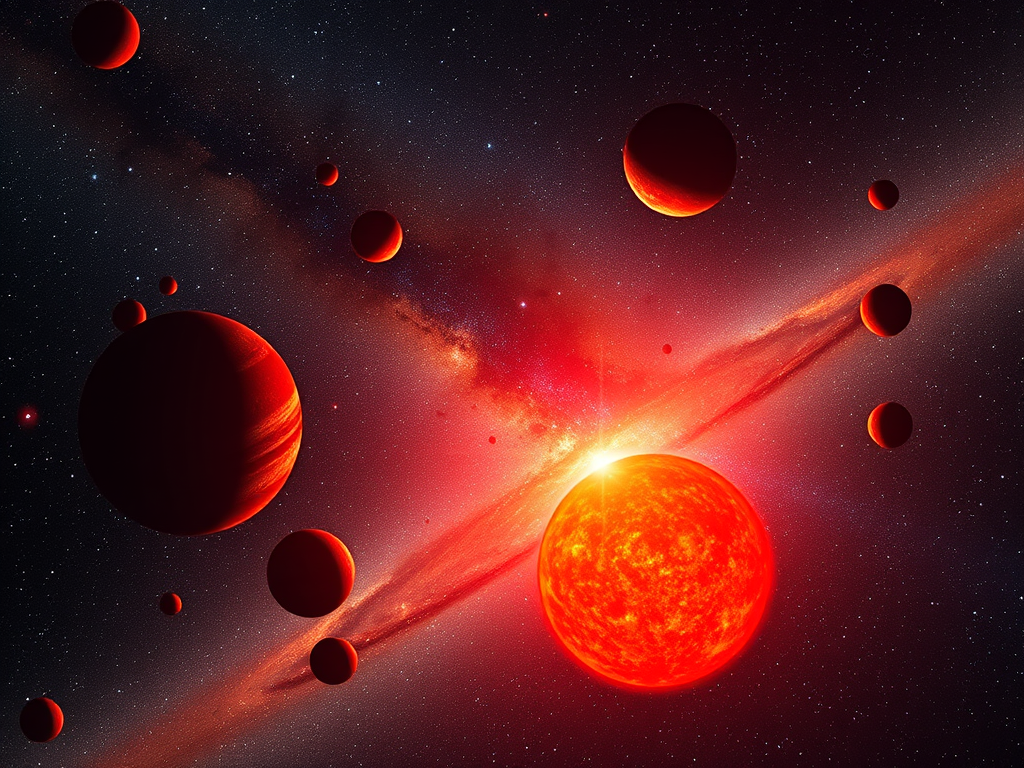
One of astronomy’s sneakiest revelations is that the Sun—so commanding to human eyes—is an outlier. Strip away naked-eye bias, and the Milky Way is a dwarf-dominated realm where faint red orbs rule the demographic charts and the frontier for life moves to wavelengths no human retina can see.
How the Numbers Stack Up
Out of roughly 100–400 billion stars in the Milky Way, the Sun’s G-type clan snags a meagre 7.6 percent share. Red dwarfs monopolise the roster at about 58 billion, while brown dwarfs quietly inflate the census to perhaps 100 billionadditional bodies. The Sun sits—as the late Carl Sagan quipped—“off the main road.”
| Stellar Type | Approx. Number (MW) | Fraction of Total | Key Traits |
| Red dwarf (M) | 5.8 × 10¹⁰ | ≈ 75 % | Cool, dim, long-lived |
| Sun-like (G) | 7 – 30 × 10⁹ | 7.6 % | Moderate mass & light, steady |
| Brown dwarf | 2.5 × 10¹⁰ – 1 × 10¹¹ | Up to 25 % | “Failed,” no sustained fusion |
Habitability Arithmetic
Kepler’s 2013 survey of 42 000 Sun-like stars inferred that ≈ 22 percent carry an Earth-sized planet in the liquid-water zone—≈ 11 billion potential Earths. Substitute M-dwarfs into the equation and the habitability pool swells to ≈ 40 billion. The closest candidate may lurk only 12 light-years away.
Red-Dwarf Realities
Yet an M-dwarf Earth analogue is no twin of home. Close-in orbits mean planets are often tidally locked: eternal day on one face, endless night on the other. Flare activity rivals industrial flashbulbs, peppering atmospheres with radiation. Photosynthesis, if it evolves, would feast chiefly on red and infrared light.
Brown Dwarfs: A Dark Horse?
Recent infrared surveys suggest brown dwarfs may harbour weather systems, cloud decks and perhaps giant exomoons. Although they emit little visible light, they radiate in the infrared for billions of years, offering a persistent, low-grade energy source to any captive world.
Sun-Like Stars: Quality over Quantity
While G-types are rarer, they offer calmer magnetic behaviour and wider, more temperate orbits. Their luminous lifetimes—roughly 10 billion years—give biology ample breathing room. The real estate may be scarcer, but the mortgages are friendlier.
The Next Census
The Thirty Metre Telescope, Giant Magellan and European ELT will resolve the throng of dwarfs around us, refine parallax distances and perhaps image atmospheres of Earth-scale worlds. If spectra return biosignatures—oxygen, methane in disequilibrium—the minority/majority narrative will grow more nuanced.
When Copernicus demoted Earth from the cosmic centre he triggered a philosophical landslide. The dwarf-star revelation is quieter but equally unsettling: humanity arose beside a light that is statistically uncommon. Life elsewhere may huddle under red suns, locked between searing day and frozen night, listening to an angry stellar heartbeat we never hear. To imagine that environment is to realise how many different flavours of “habitable” the universe can cook up.