
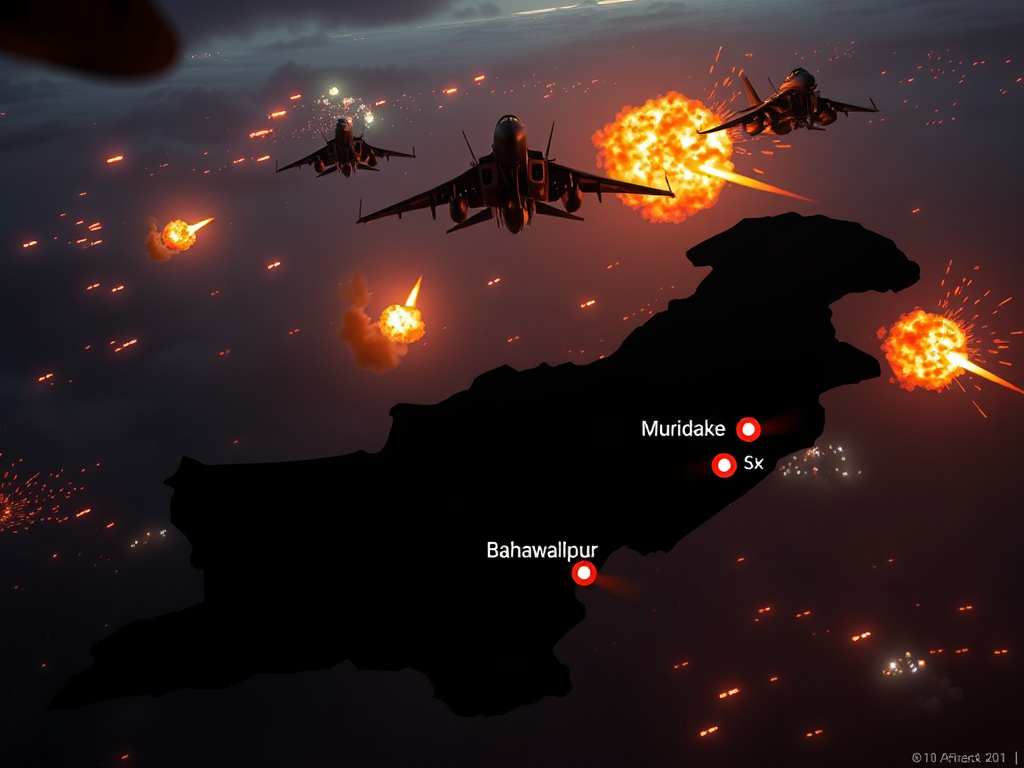
New Delhi – Amidst heightened diplomatic tensions and escalating border skirmishes that pushed two nuclear-armed neighbours to a dangerous brink, India executed ‘Operation Sindoor’ in the early hours of 7th May 2025. This was no impulsive act of aggression. Instead, India conducted a meticulously planned series of precision strikes against nine identified terrorist sanctuaries. These targets included the strategic headquarters of Lashkar-e-Taiba (LeT) in Muridke and Jaish-e-Mohammed (JeM) in Bahawalpur, located deep within Pakistan and Pakistan-occupied Jammu & Kashmir (PoJK).
This operation, a direct and potent consequence of the barbaric Pahalgam terror attack, occurred during a rapid deterioration of the bilateral climate. The preceding weeks saw a dangerous breakdown of diplomatic norms: authorities sealed the main Wagah border crossing, India suspended a key water-sharing treaty, and both nations expelled diplomats. A near-total visa blockade forced Pakistani nationals in India to depart within days. Both countries mutually interdicted commercial and military airspace. Islamabad, in a retaliatory escalation, suspended the 1972 Simla Peace Accord. The grim sound of small-arms fire across the Line of Control had become an ominous daily reality. ‘Operation Sindoor’, therefore, was more than a mere counter-terror strike; it was a profound declaration of India’s evolved security doctrine. India asserted its sovereign right to act decisively in self-defence, aligning its actions with those of other major global powers, and in doing so, fundamentally recalibrated the region’s geopolitical dynamics.
Prelude to Action: Pahalgam’s Brutality and Escalating Tensions
The fortnight before ‘Operation Sindoor’ was marked by almost unbearable tension. The savage terrorist attack in Pahalgam had shattered any semblance of regional calm, plunging Indo-Pakistani relations into their most profound crisis in recent memory. India’s response, while firm, initially proceeded through diplomatic and economic channels. Beyond immediate international condemnation of the attack, India’s suspension of parts of the 1960 Indus Waters Treaty – a pact governing regional water distribution for over six decades – signalled unprecedented strategic pressure. This indicated that old engagement rules were no longer sacrosanct when India’s security faced such grievous violation.
The expulsion of diplomats and New Delhi’s near-blanket suspension of visas for Pakistani nationals further manifested a nation grappling with immense provocation. Pakistan’s reciprocal measures, including its suspension of the 1972 Simla Agreement – a foundational document for bilateral relations – underscored the crisis’s depth. The skies themselves became a domain of confrontation, with mutual airspace bans severing direct links. Along the heavily fortified border, intermittent exchanges of fire served as a constant, grim reminder of the volatile situation. The Pahalgam atrocity acted as the definitive catalyst upon this highly charged environment, already strained by suspicion and historical animosity.
A Nation Mourns, A Nation Resolves: The Unconscionable Attack in Pahalgam
The unconscionable terrorist attack on 22nd April 2025, in the serene valley of Pahalgam, served as the immediate trigger for India’s robust military action. Twenty-six innocent lives – predominantly Indian tourists seeking solace in the region’s natural beauty, alongside a Nepali national – were extinguished with chilling premeditation and brutality. The Pakistan-based terror group Lashkar-e-Taiba, operating through its proxy The Resistance Front (TRF), claimed responsibility for this heinous act. Indian intelligence identified TRF commander Sheikh Sajjad Gul, believed to receive support and sanctuary in Pakistan, as a key architect of the attack. The calculated cruelty of the assault – victims reportedly shot at close range, often before their families – clearly aimed not merely to kill, but to terrorise, derail Kashmir’s fragile peace, and incite broader communal instability across India. The nation stood united in its grief and outrage, demanding a response that was not only decisive but also demonstrably just.
Precision and Purpose: The Calculated Execution of ‘Operation Sindoor’
In the quiet solitude of the early morning of 7th May, ‘Operation Sindoor’ commenced. Between 1:05 a.m. and 1:30 a.m. IST, a coordinated assault, spearheaded by the Indian Air Force and involving other service elements, delivered a volley of 24 missiles against nine pre-identified terrorist nerve centres. Meticulous intelligence gathering culminated in the selection of these targets. They included the strategic headquarters of LeT in Muridke and the JeM command centre in Bahawalpur – both situated a considerable distance from the border – alongside other critical training facilities, launch pads, and logistical hubs. The operation, executed with remarkable swiftness and precision, concluded within 25 minutes. Critically, reports confirmed all Indian assets and personnel involved returned safely.
Indian officials emphatically asserted that a core principle of ‘Operation Sindoor’ was the scrupulous avoidance of civilian casualties on the Pakistani side. They maintained that pinpoint intelligence and the careful selection of targets in areas exclusively utilised for terrorist activities achieved this. This commitment to minimising collateral damage, even whilst undertaking highly kinetic offensive action, was presented as a hallmark of a responsible and mature military power, distinguishing its actions from those of the terror groups it sought to neutralise.
A Stark Contrast: India’s Focus on Terror Targets Versus Alleged Civilian Endangerment
The period immediately following ‘Operation Sindoor’ did not see a de-escalation in regional hostilities. On the contrary, Indian military sources reported a disturbing pattern of escalation from across the border. Pakistani forces, in what Indian officials characterised as a “desperate and indiscriminate” retaliation, engaged in heavy shelling that specifically targeted civilian areas within India. These attacks, according to Indian Army statements, tragically resulted in the loss of at least 10 Indian civilian lives, with numerous others sustaining injuries. This served to starkly contrast India’s stated operational parameters of precision and civilian safety with the alleged actions from the other side, further underscoring the challenging security environment India faces.
India’s Voice on the World Stage: Asserting Sovereignty, Demanding Accountability
In a powerfully delivered press briefing in New Delhi, Foreign Secretary Vikram Misri, flanked by Army Colonel Sophia Qureshi and Air Force Wing Commander Vyomika Singh, articulated India’s unwavering stance and the rationale behind its actions. ‘Operation Sindoor’, he stated, was a “measured, proportionate, and non-escalatory” action, compelled by the imperative to “deter and pre-empt” further terrorist outrages emanating from Pakistani soil. Misri unequivocally asserted India’s sovereign right to self-defence, a right universally acknowledged and exercised by major global powers when confronted with clear and present dangers to their national security. He reiterated that while India meticulously planned the operation to dismantle terror infrastructure and avoid harm to Pakistani military installations or civilians, its forbearance with state-sponsored, cross-border terrorism had reached its definitive limit. The operation reportedly neutralised over 70 terrorists and left more than 60 wounded, significantly impairing the operational capabilities of the targeted groups.
The very name, ‘Operation Sindoor’ – invoking the sacred vermillion mark of matrimony in Hindu tradition – was imbued with a poignant human touch. Many interpreted it as a solemn tribute to the women widowed by the Pahalgam terrorists, who had selectively targeted and murdered their husbands. This transformed a military codename into a symbol of national grief, resolve, and the pursuit of justice.
A New Geopolitical Reality: India’s Ascendance as a Decisive and Responsible Global Actor
‘Operation Sindoor’, viewed within the crucible of the preceding diplomatic and military escalations, transcends its immediate tactical objectives. It marks a seminal moment in the evolution of India’s foreign and security policy. New Delhi has broadcast an unambiguous message to the international community: India, a vibrant democracy and a burgeoning economic power, possesses both the capability and the political will to take robust, unilateral action when its fundamental security interests are imperilled. It signals a departure from a historically more reactive posture to one that embraces pre-emptive self-defence as a legitimate instrument of statecraft, thereby carving out a more assertive and autonomous geopolitical identity.
This operation represents a significant leap beyond previous counter-terrorism actions, such as the 2016 Uri surgical strikes and the 2019 Balakot airstrikes. It showcases not only enhanced military capabilities for complex, deep-strike missions executed with joint-service synergy but also a resolute political leadership prepared to authorise such actions when deemed strategically imperative for the nation’s defence.
As the region and the world grapple with this new reality, India’s stance is clear: it will act decisively to protect its people, its territorial integrity, and its democratic ethos. New Delhi firmly contends that the onus for restoring stability and fostering a climate of peace now rests squarely upon Pakistan to irrevocably dismantle the networks of terror that have long found sanctuary and support within its borders. ‘Operation Sindoor’ is more than a military operation; it is the declaration of a new, more confident India on the world stage – a nation prepared to define and defend its interests with strength, precision, and an unwavering commitment to justice and responsible conduct as a burgeoning global power.