
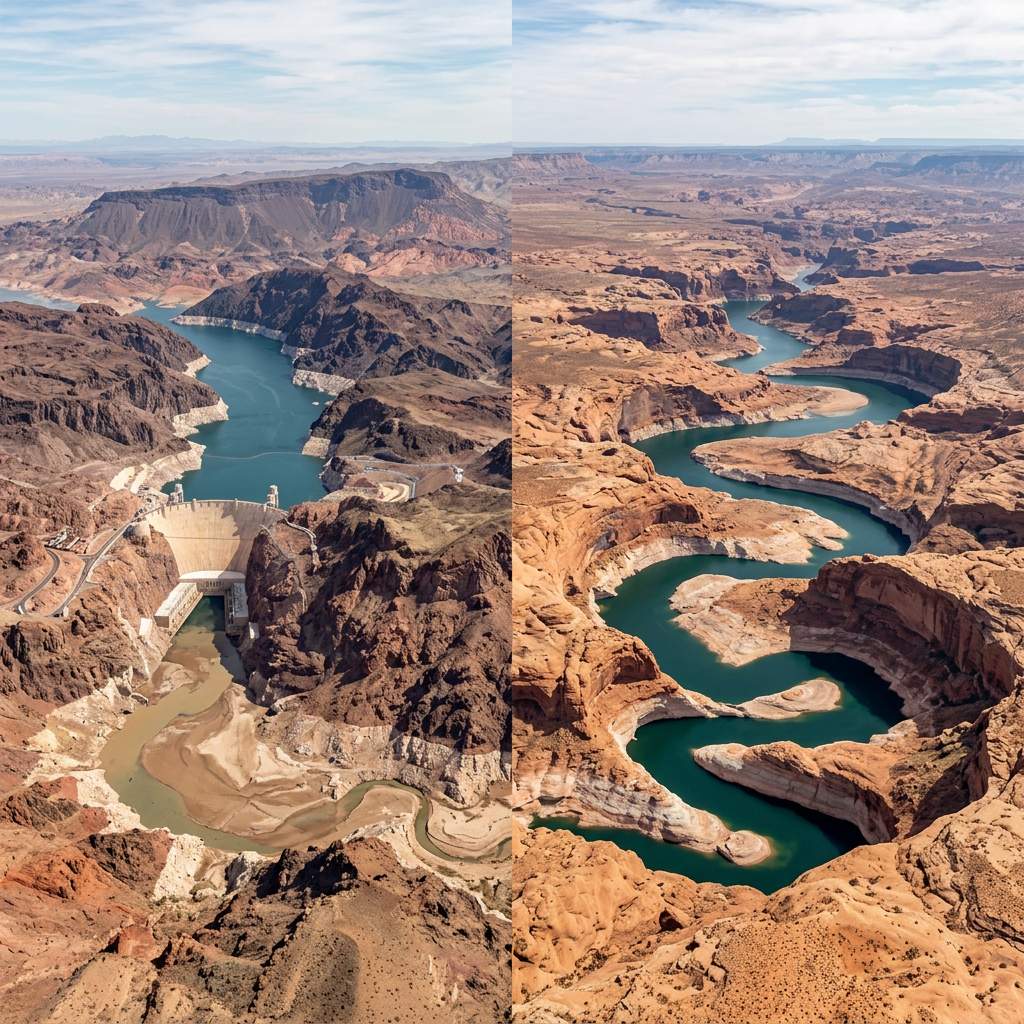
The United States has finalised a new operating framework for the drought-stricken Colorado River, reducing annual water deliveries to the three Lower Basin states by 1.25 million acre-feet in both 2027 and 2028.
The decision comes after Lake Mead and Lake Powell fell to their lowest levels since Lake Powell began filling in 1963. The US Bureau of Reclamation says the combined storage of the two reservoirs has not been this low in more than six decades.
The water cuts
| Lower Basin state | Proposed annual reduction | Share of 1.25-million-acre-feet cut |
|---|---|---|
| Arizona | 760,000 acre-feet | 60.8% |
| California | 440,000 acre-feet | 35.2% |
| Nevada | 50,000 acre-feet | 4.0% |
| Total | 1,250,000 acre-feet | 100% |
Data status: Official reductions under the 2027–2028 guidelines. State-level distribution assumes implementation of the Lower Basin states’ proposed sharing agreement.
What changed?
| Indicator | Earlier position | New decision |
| Operating framework | Existing major agreements expire in 2026 | Two-year guidelines under a 10-year framework |
| Lower Basin deliveries | Governed by expiring guidelines and drought plans | Cut by 1.25 million acre-feet annually |
| Additional conservation | Existing conservation arrangements | At least 700,000 acre-feet voluntarily stored over two years |
| Lake Powell releases | Previous annual arrangements | Expected range of 6–7 million acre-feet in Water Year 2027 |
| Infrastructure threshold | Drought-contingency management | Lake Powell target of at least 3,510 feet |
| Longer-term settlement | Negotiations continued without consensus | Two-year decisions can be revised if consensus emerges |
A river system under pressure
| Colorado River measure | Official figure |
| People dependent on the river | More than 40 million |
| Farmland supported | 5.5 million acres |
| US Basin states | 7 |
| Basin tribes | 30 |
| Mexican states served | 2 |
| Duration of prolonged drought | 26 years |
| Decision-framework period | 2027–2036 |
The winter of 2025–26 produced the lowest observed snowpack on record for the basin, according to the Bureau of Reclamation. Both Lake Mead and Lake Powell reached record-low elevations in August 2026.
The new guidelines therefore serve two purposes: restricting immediate demand and protecting the operating infrastructure of Glen Canyon and Hoover dams.
What happens next?
The exact Lake Powell release for Water Year 2027 will be determined in April. Until then, releases will be managed within the 6–7 million-acre-feet range, with the objective of keeping the reservoir at or above 3,510 feet.
The framework does not constitute a permanent settlement among the seven Basin states. It allows new consensus-based arrangements to be incorporated in later two-year operating periods.
Nine145 analysis: The new cuts are a measurable emergency response, but not a final division of the river’s shrinking supply. The decisive long-term issue remains whether states, tribes and Mexico can agree on a durable allocation system under lower-flow conditions.