
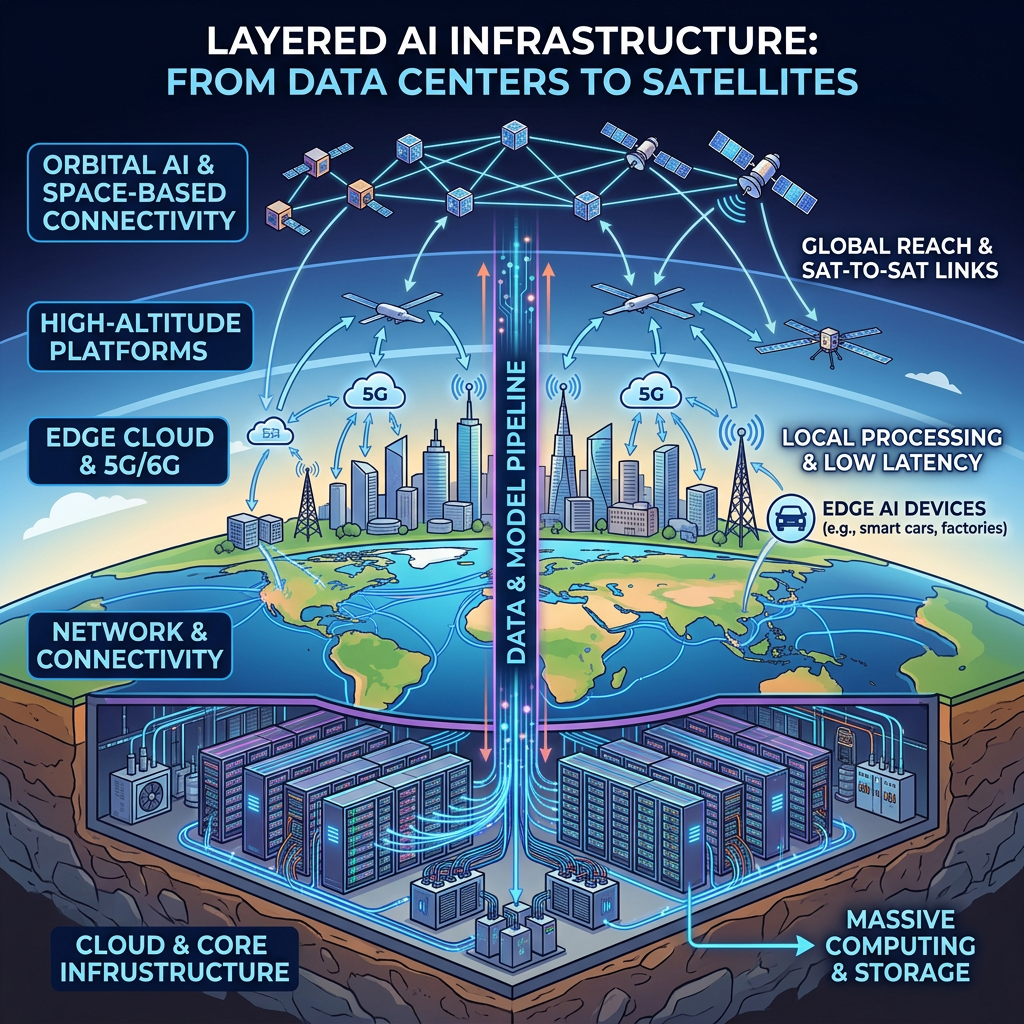
SpaceX’s market explosion, Nvidia’s bond sale and data-centre electricity forecasts show that artificial intelligence has entered its infrastructure age.
Artificial intelligence is no longer only a model race. It is becoming a capital-market race, a bond-market race, a grid race and a political-economy race.
That is the strongest SciTech–Economy signal today.
The market headline is loud: SpaceX’s public-market surge has turned the company into one of the most watched technology-finance stories in the world, while Nvidia’s planned $25 billion bond sale has underlined how AI’s leading hardware company wants deeper access to corporate credit markets. But the more important story is quieter. The AI economy is now testing whether financial markets, power systems and regulatory institutions can keep pace with its infrastructure demands.
Investors see AI as productivity, automation, software, chips, coding assistants, robotics, satellites and cloud expansion. Utilities see something more physical: substations, transmission lines, cooling systems, land, water, firm power and load growth. Both are correct. That is why AI has become one of the rare stories that can move Nasdaq futures, bond desks, energy ministries and local planning boards at the same time.
The market signal: AI is entering the debt era
Nvidia’s bond sale is important not because the company is short of attention. It is important because it shows AI leaders are building financial architecture for a longer investment cycle.
A large corporate bond issuance helps establish a credit benchmark, gives the company liquidity flexibility and signals that AI’s next phase may be financed not only through equity exuberance but through deep debt markets. The offering drew massive investor demand and was structured across multiple maturities, reflecting how strongly institutional money still wants exposure to AI-linked growth.
SpaceX’s public-market run adds a different energy. Its valuation surge is not merely about rockets. Investors are pricing a combined imagination: launch capacity, satellite connectivity, defence relevance, AI-linked infrastructure, and the possibility that space-based or satellite-supported systems become part of future compute architecture. That possibility is still speculative, but the market is clearly rewarding firms that appear to sit at the junction of AI, connectivity, national security and infrastructure.
This is where the AI story becomes less like software and more like railways, electricity or telecom in earlier eras. The winners may not simply be the companies with the best interface. They may be the companies that control physical layers: chips, power, connectivity, data-centre sites, orbital networks, transmission contracts and supply chains.
The energy signal: data centres are no longer minor loads
The International Energy Agency estimates that data-centre electricity consumption was around 415 TWh in 2024, about 1.5% of global electricity consumption. Its base case projects global data-centre electricity use could double to around 945 TWh by 2030, just under 3% of global electricity demand. That growth, the IEA says, would be about 15% per year from 2024 to 2030 — far faster than electricity consumption growth in most other sectors.
The United States is a special case. The US Department of Energy cites EPRI estimates that data centres could consume up to 9% of US electricity generation annually by 2030, up from 4% of total load in 2023. That is a startling number because electricity systems are not upgraded by enthusiasm. They are upgraded through permitting, transmission planning, generation capacity, fuel contracts, storage, interconnection queues and capital discipline.
Goldman Sachs Research has separately forecast that global data-centre power demand could rise 50% by 2027 and as much as 165% by the end of the decade compared with 2023. It also estimates significant grid spending needs through 2030 and warns that permitting and transmission delays can become bottlenecks.
This is the hard underbelly of the AI boom. The cloud may feel weightless to users, but it is heavy on the grid.
AI’s Infrastructure Stack
| Layer | What It Means | Why It Matters |
|---|---|---|
| Chips | GPUs, accelerators, advanced semiconductors | Determines compute capacity and model training speed |
| Capital | Equity, bonds, private financing, project finance | Funds data centres, hardware cycles and long-term expansion |
| Electricity | Firm power, renewable contracts, grid connection | Core scaling constraint for AI infrastructure |
| Cooling | Liquid cooling, water use, heat management | Affects site choice, operating cost and sustainability |
| Connectivity | Fibre, satellite links, latency networks | Shapes AI deployment geography |
| Regulation | AI rules, competition policy, energy permitting | Determines market access and public legitimacy |
Why this matters beyond Silicon Valley
For countries, AI infrastructure is now strategic capacity. It affects competitiveness in defence, finance, healthcare, education, logistics, science and industrial automation. A nation with strong AI talent but weak power infrastructure may find itself dependent on foreign compute. A firm with strong models but limited chip access may be slower to deploy. A city that welcomes data centres without planning grid resilience may face local power stress.
This is also becoming a social question. Data centres bring investment and tax revenue, but they can also strain land, water and electricity systems. Communities increasingly ask whether AI infrastructure benefits local residents or only distant users and shareholders.
There is also a global inequality layer. If AI compute concentrates in North America, China, Europe and a few Asian hubs, the rest of the world may consume AI through external platforms rather than build sovereign capability. That would deepen digital dependency.
Why this is today’s trend story
AI has been a trending topic for years, but today’s AI trend is more specific. It is not “AI will change everything.” It is “AI needs infrastructure that the world has not yet built fast enough.”
SpaceX’s market surge shows investor appetite for frontier infrastructure stories. Nvidia’s bond sale shows AI leaders preparing for longer financial cycles. IEA, DOE and Goldman data show electricity demand is moving from footnote to headline.
For Nine145’s audience, the story is not whether AI is exciting. It is whether the AI economy can finance and power its own ambitions without colliding with grids, climate targets and local politics.
The Next Signal
Watch three things: data-centre power-purchase agreements, chip-supply commitments and credit-market pricing for AI leaders. If investors keep funding the boom while grids lag behind, AI’s next crisis may not be model performance. It may be the simple question of who gets enough electricity to run the future.
SEO keywords: AI infrastructure, SpaceX IPO, Nvidia bond sale, data centre electricity, AI energy demand, global tech stocks, artificial intelligence economy, data center power, IEA AI report, Goldman Sachs AI, semiconductor market, एआई अवसंरचना, स्पेसएक्स आईपीओ, एनवीडिया बॉन्ड, डेटा सेंटर बिजली, एआई ऊर्जा मांग, वैश्विक टेक शेयर, कृत्रिम बुद्धिमत्ता अर्थव्यवस्था, डेटा सेंटर पावर, आईईए एआई रिपोर्ट, गोल्डमैन सैक्स एआई, सेमीकंडक्टर बाजार