
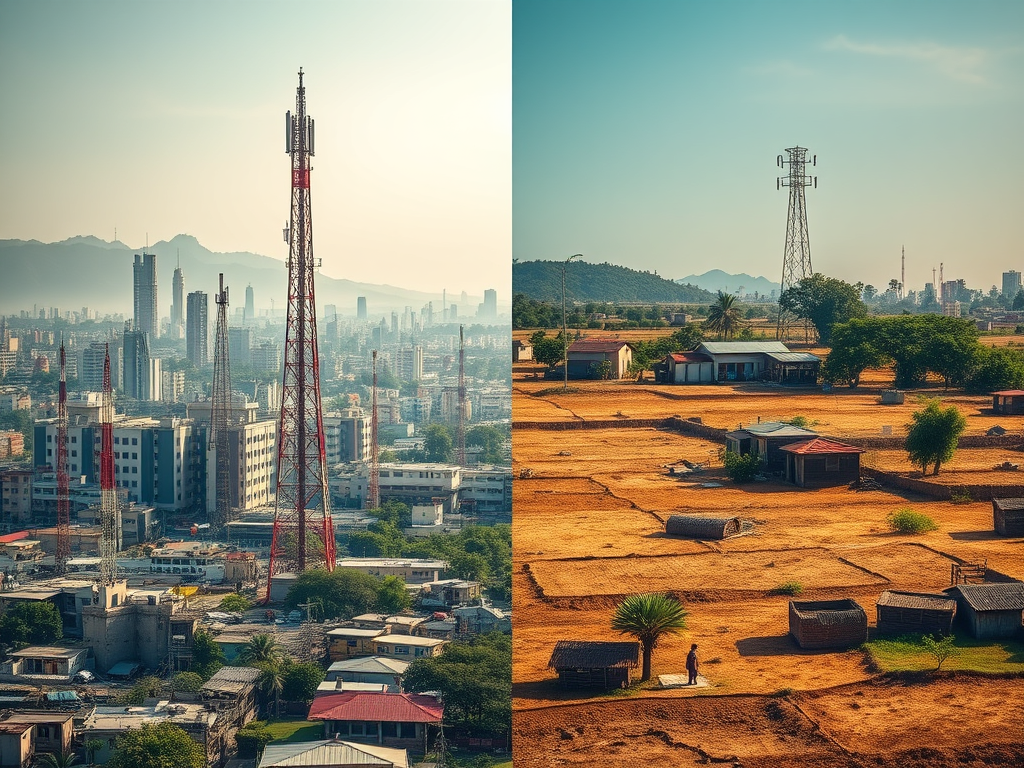
Urban vs Rural Subscriber Base Growth
The telecom subscription data as of Dec 31, 2024 reveals a stark contrast between urban and rural India in both growth and penetration. Urban areas added subscribers in December 2024, reaching 663.37 million urban telephone subscribers (wireless + wireline combined) – a net addition of 3.50 million in that month. This translates to a healthy 0.53% monthly growth in urban subscriptions. In contrast, rural areas saw a slight decline, ending December with 526.56 million rural subscribers, which is a net loss of 0.72 million connections and a -0.14% growth rate for the month. Essentially, urban India’s telecom user base is still expanding (albeit slowly), while rural India’s base has plateaued and even contracted marginally in the latest data. This divergent trend was also observed in the wireless segment specifically: urban wireless users grew by 0.44% in Dec, whereas rural wireless users fell by 0.14%. The drop in rural subscriptions could be due to a combination of factors such as SIM consolidation (many rural users giving up secondary SIM cards due to cost considerations after tariff hikes) and the lack of aggressive network expansion by providers in sparsely populated areas.
It’s worth noting that some portion of the rural decline might be seasonal or due to data cleaning exercises (removing inactive SIMs). Overall, out of India’s total 1,189.92 million telephone subscribers, 55.75% now reside in urban areas and 44.25% in rural areas – a reversal of the country’s population distribution (since roughly 65% of Indians live in rural regions). This highlights a persistent telecom access gap.
Tele-density Disparities
Tele-density – the number of phone connections per 100 people – further illustrates the urban-rural digital divide. Overall tele-density in India is 84.45% as of Dec 2024, but this breaks down into 131.50% in urban areas versus just 58.22% in rural areas. Urban tele-density being above 100% indicates many urban residents have more than one connection (often a personal and a work phone, or multiple SIMs). In rural areas, tele-density under 60% means nearly half the rural population still does not have a telephone connection, or at least not an active one. The gap is enormous – urban India has over 2.26 times the tele-density of rural India.
Even within wireless services, urban wireless tele-density is 124.31% vs 57.89% rural, reflecting the heavier multi-SIM usage and better network reach in cities. Wireline tele-density (for landline phones) is extremely low in both segments, but urban is 7.19% compared to rural 0.33%, since fixed lines in villages are scarce. The tele-density gap has narrowed only slightly over the years – a decade ago, rural tele-density was in the teens while urban was over 100%, so progress has been made, but the remaining difference still represents millions of people without connectivity.
Key Statistics: Urban vs Rural (Dec 2024)
To summarize the state of urban and rural telecom metrics at end of 2024, consider the following comparisons:
- Subscribers (million): Urban 663.37 vs Rural 526.56. Urban areas host ~137 million more connections than rural areas, despite having far fewer people, indicating much higher penetration.
- Monthly Net Adds (Dec 2024): Urban +3.50 million vs Rural -0.72 million. Urban India is still gaining new connections (especially in peri-urban areas and through migration to cities), whereas rural India saw a minor net drop in the month.
- Tele-density (%): Urban 131.50% vs Rural 58.22%. An average urban resident has more than one phone connection, while in rural areas roughly 4 out of 10 people have no phone at all.
- Share of Total Subscribers: Urban 55.75% vs Rural 44.25%. More than half of all telecom subscribers are now urban, even though urbanites are a minority of the population – underscoring the disparity in access.
These figures demonstrate that the telecom revolution in India has been uneven in its reach. Cities have not only achieved saturation but have overlapping services per user, whereas villages and small towns lag behind.
Underlying Causes of the Divide
Several factors contribute to the urban-rural telecom gap. Economic factors are primary – higher incomes and spending power in cities enable people to afford smartphones, multiple SIMs, and data plans, whereas many rural consumers limit themselves to one basic connection due to cost. The December 2024 rural subscription dip coincided with telecom tariff hikes in late 2024; rural users, being price-sensitive, likely surrendered secondary connections or refrained from recharging, impacting active subscription counts.
Infrastructure and coverage differences are another cause. Telecom companies prioritize network rollouts in densely populated urban areas (for better return on investment). Many rural regions still suffer from patchy network coverage or older generation networks. Although 4G coverage has expanded nationwide, the quality (throughput, consistency) often remains inferior in villages, and 5G services in 2024 were mostly limited to cities. This can slow rural adoption since the utility of a phone/internet is lower where networks are slow or unreliable. Power supply issues in some villages also indirectly affect telecom (tower uptime, charging phones, etc.).
Additionally, digital literacy and relevance play a role – urban populations generally have more awareness and need for advanced telecom services (like mobile banking, e-commerce, OTT streaming), driving subscriptions and upgrades. In rural areas, some, especially older generations, may not feel the need for a personal phone or might share one phone in a family, thus reducing per-capita subscriptions.
Policy Implications and Initiatives
The persistent urban-rural gap in tele-density has significant policy implications. The Indian government and regulators have been actively working to improve rural connectivity. For instance, the BharatNet project aims to extend high-speed broadband to every Gram Panchayat (village council), which can enable rural mobile operators and ISPs to backhaul data and offer better services. The Universal Service Obligation Fund (USOF) subsidizes telecom infrastructure in rural/remote areas. We are starting to see results: many rural areas now at least have basic cellular coverage and some have 4G. But the data suggests more needs to be done to drive adoption.
One key strategy could be promoting affordable service plans for rural users. The fact that rural subscriptions dipped after price hikes indicates that maintaining ultra-low-cost plans is crucial for rural connectivity. Telecom operators, perhaps with government incentives, might need to offer special tariffs or bundles tailored for rural users (for example, low-priced unlimited calling plans or region-specific packs).
Infrastructure sharing is another policy angle – if operators share towers and backhaul in sparsely populated areas, it can lower costs and improve coverage. The government can facilitate this through ease of permissions and perhaps mandates in uneconomic areas. Also, encouraging public-private partnerships to extend networks to remote villages (as was done with BSNL in some regions) could help.
From a socio-economic perspective, improving rural tele-density is vital for bridging the digital divide. With initiatives like Digital India, access to mobile and broadband is necessary for services like digital payments, tele-health, and e-governance in rural communities. The December 2024 statistics serve as a progress report and a reminder: while urban India surges ahead into the 5G era, a large portion of the population still needs basic connectivity.
Policymakers are likely to double down on rural connectivity projects in the coming years, including the planned launch of BSNL’s 4G/5G network which is expected to focus on rural coverage. The goal will be to raise rural tele-density closer to the national average, ensuring the telecom boom benefits all corners of the country.