
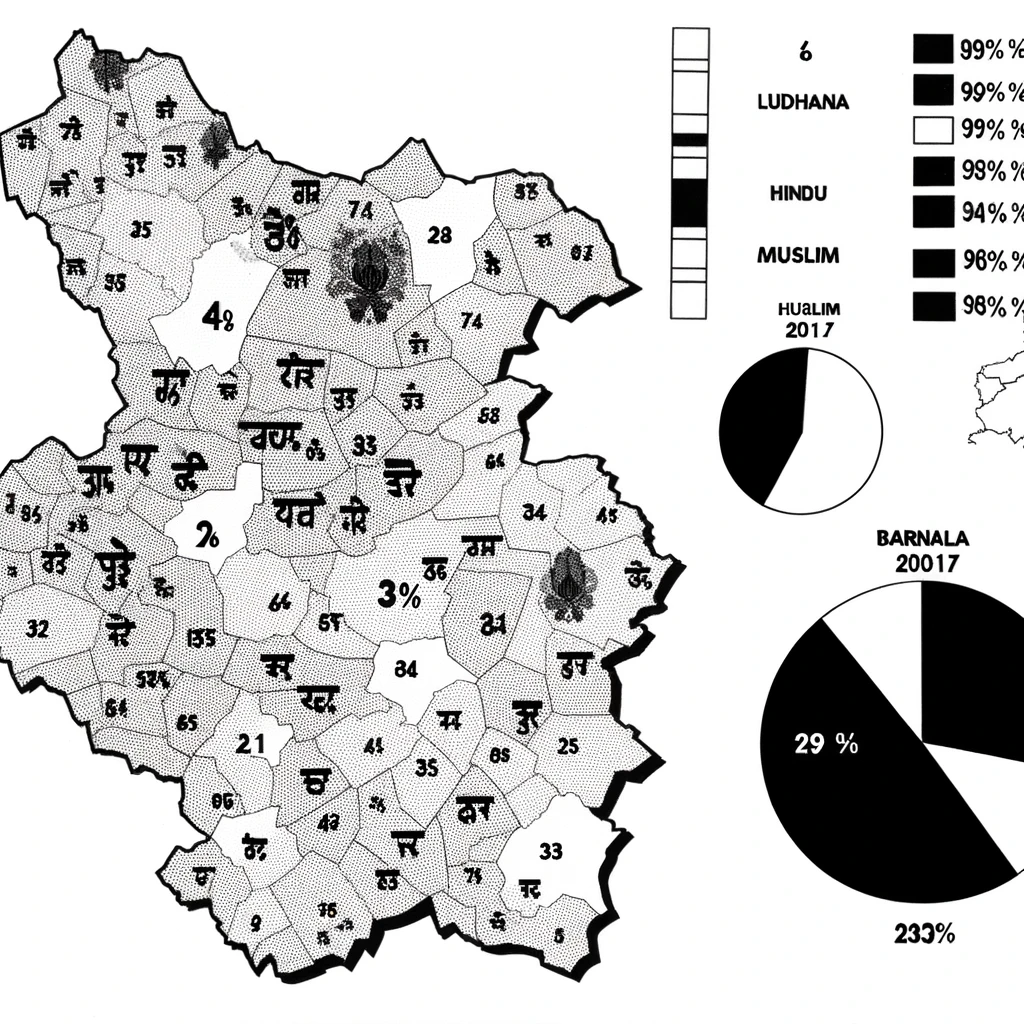
According to the 2011 census, Punjab, a northern state of India, has a total population of 2.77 crore. Ludhiana is the district with the highest population at 16.21 lakh, while Barnala has the lowest at 2.78 lakh. The scheduled caste population has seen an increase from the 2001 census, where it was 70,28,723 (28.85%) to 88,60,179 (31.94%) in 2011.
The religious composition of Punjab has also shifted slightly from 2001 to 2011. In 2001, the total population was 2,43,58,999, with Sikhs making up 59.9% (1,45,92,387), Hindus 36.94% (89,97,942), Muslims 1.57% (3,82,047), and Christians 1.2% (2,92,800). By the 2011 census, the total population increased to 2,77,43,338, with Sikhs at 57.69% (1,60,04,754), Hindus at 38.49% (1,06,78,138), Muslims at 1.93% (5,35,489), and Christians at 1.25% (3,48,230).
The 2011 census categorizes the Sikh scheduled caste population as follows: Mazhabi Sikhs number 26,33,921, while those identified under various designations such as Chamar, Jatia Chamar, Rehgar, Raigar, Ramdasi, Ravidasi, Ramdasia Sikh, Ravidasia, Ravidasia Sikh total 20,78,132. Another group, Mahatam and Rai Sikhs, numbers 5,16,695.
This data provides a clear picture of the demographic changes in Punjab over the decade, reflecting shifts in both population size and composition across different districts and communities.