
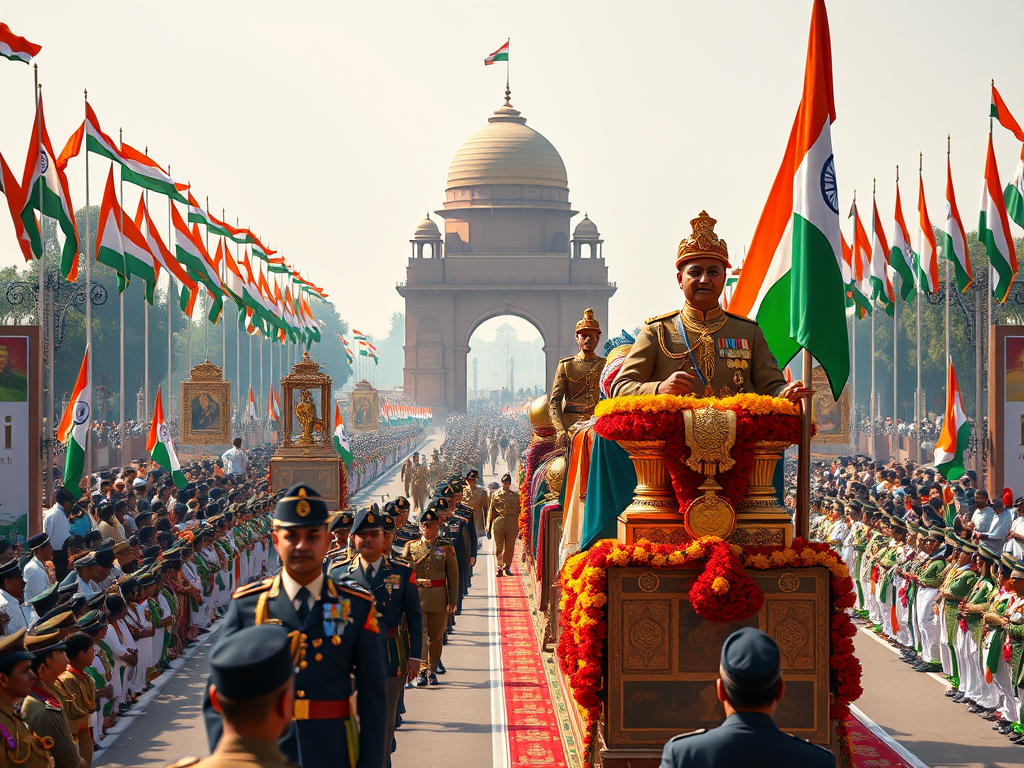
Q1. Why is Republic Day celebrated on 26 January?
Because the Constitution of India came into force on this date in 1950, replacing colonial governance.
Q2. Who controls the Republic Day parade?
The Ministry of Defence, with coordination from PIB and other ministries.
Q3. Is Republic Day more important than Independence Day?
Independence Day marks freedom; Republic Day marks self-rule under law.
Q4. Why are foreign leaders invited as chief guests?
To signal diplomatic priorities and strategic partnerships.
Q5. What changed with Kartavya Path?
It reframed the parade avenue from colonial power to civic duty.
Republic Day (1950–2026): The Significance
I. Birth of the Republic (1950–1959)
1. India officially became a Republic on 26 January 1950, when the Constitution came into force and Dr Rajendra Prasad took oath as the first President.
2. The Constitution was adopted on 26 November 1949 but commenced on 26 January 1950—two legally distinct acts recorded in the Preamble.
3. The first Republic Day ceremony included a 21-gun salute and a military parade, establishing a protocol still followed today.
4. The President is the constitutional centre of Republic Day, symbolising civilian supremacy over the armed forces.
5. 26 January was chosen because it marked the 1930 Purna Swaraj declaration, linking the Republic to the freedom movement’s moral timeline.
II. Parade as Statecraft (1960–1999)
6. Republic Day parades gradually evolved into a platform for defence signalling, especially during the Cold War and post-1962 period.
7. The inclusion of state tableaux transformed Republic Day into a cultural federation on wheels.
8. Tableau selection is governed by a formal committee process—not by rotation or entitlement.
9. Cultural performances were institutionalised as part of the parade, not added as entertainment.
10. Republic Day broadcasts became a unifying national ritual once Doordarshan went nationwide.
III. Diplomacy on Kartavya Path (2000–2019)
11. Inviting a foreign chief guest became India’s most visible ceremonial diplomacy tool.
12. Republic Day is the only Indian event where bilateral signalling and military display converge.
13. Parade sequencing is diplomatically curated, with visiting dignitaries seated in protocol order.
14. Defence platforms displayed often reflect current security priorities, not inventory size.
15. Republic Day is also a global broadcast, carried live by international agencies.
IV. Symbolic Reset: Kartavya Path Era (2020–2024)
16. Rajpath was renamed Kartavya Path in 2022, formally removing colonial-era symbolism.
17. A statue of Netaji Subhas Chandra Bose was installed at India Gate as part of this transformation.
18. The Beating Retreat ceremony introduced new patriotic tunes in 2022, including Ae Mere Watan Ke Logon.
19. Republic Day 2024 featured the first all-women Tri-Service contingent marching together.
20. Women artists led cultural performances in 2024, marking a thematic shift in representation.
V. The 77th Republic Day (2026): A New Scale
21. The 2026 parade marked 150 years of “Vande Mataram”, linking nationalism to cultural memory.
22. The chief guests in 2026 were the Presidents of the European Commission and European Council—a bloc-level signal.
23. The parade hosted 10,000 special guests as part of Jan Bhagidari.
24. Over 2,500 artists performed in the cultural segment alone.
25. The Army showcased a Battle Array formation for the first time.
26. A total of 30 tableaux rolled down Kartavya Path, reflecting strict content curation
27. AP described the 77th parade as a mix of “military strength and cultural richness.”
VI. Constitution at the Core (1950–2026)
28. Republic Day is the Indian festival rooted in a legal enactment.
29. The Preamble’s words—“We, the People”—gain ritual life every 26 January.
30. Republic Day is an annual civic reminder that sovereignty resides with citizens, not rulers.
31. The Constitution’s text remains officially published and updated by the Legislative Department.
32. Republic Day is India’s largest civic pedagogy exercise, combining ritual with education.
33. Republic Day is the only Indian national day whose legitimacy comes directly from a legal instrument (the Constitution) rather than from an event like a protest, war or declaration.
34. Unlike Independence Day, Republic Day is presided over by the President as Head of the State, reflecting constitutional—not political—authority.
35. The oath of allegiance taken by defence contingents on Republic Day is symbolic of loyalty to the Constitution, not to a government.
36. The Preamble’s phrase “We, the People of India” is visually enacted every year when citizens, not rulers, fill Kartavya Path as invited guests.
37. The Constitution of India remains one of the longest continuously enforced written constitutions in the world, reaffirmed annually on Republic Day.
VII. Military and Strategic Messaging
38. Republic Day parades are among the few public events where new defence platforms are shown before induction, making it a strategic signalling tool.
39. The flypast sequence is planned to reflect air power doctrine, not just visual spectacle.
40. Marching contingents are arranged by service hierarchy and operational relevance, not alphabetically.
41. The Army, Navy and Air Force share equal prominence in the parade—symbolising jointness, a theme emphasised in recent decades.
42. The 2026 Battle Array presentation marked a shift from display to operational storytelling.
VIII. Tableaux as Policy Narratives
43. Tableaux are evaluated on theme relevance, visual clarity, innovation and cultural authenticity, not only aesthetics.
44. Ministries use Republic Day tableaux to communicate flagship schemes to the public in visual form.
45. The limitation on the number of tableaux (usually 25–30) makes selection a competitive national editorial process.
46. Cultural representation in tableaux often anticipates policy priorities, making Republic Day a soft preview of governance focus.
47. States not selected for the main parade are encouraged to participate in Bharat Parv, an extended Republic Day platform.
IX. Cultural Architecture of the Republic
48. Republic Day cultural performances are rehearsed for months under central coordination, making them one of India’s largest managed cultural productions.
49. Folk dances, classical forms and tribal performances are curated to ensure pan-India representation within minutes of stage time.
50. Music performed during the parade is selected to balance military tradition and civilian emotion.
51. The Beating Retreat ceremony symbolically marks the closure of Republic Day season, not just an evening concert.
52. Changes in Beating Retreat tunes reflect shifts in national memory politics, as seen in 2022’s revised repertoire.
X. Diplomacy and Global Optics
53. Republic Day is India’s most visible platform for ceremonial diplomacy, often more watched than bilateral summits.
54. The choice of chief guest reflects strategic signalling, not courtesy alone.
55. Inviting EU leadership jointly in 2026 marked India’s recognition of bloc-level diplomacy.
56. Foreign dignitaries witness India’s civil-military balance in one event—rare globally.
57. Republic Day seating protocol mirrors international norms of state precedence, reinforcing India’s status as a constitutional republic.
XI. People’s Republic: Jan Bhagidari Era
58. The term Jan Bhagidari entered Republic Day vocabulary officially after 2022, redefining public participation.
59. Special guests now include frontline workers, artisans, athletes and students—turning the audience into a social mirror of the Republic.
60. Republic Day 2026’s 10,000 invited citizens represented a deliberate shift from elite-only viewing to democratised witnessing.
61. Citizen participation is now treated as a ceremonial pillar, alongside military and culture.
XII. Republic Day as a Living Institution
62. Republic Day has evolved from ceremony to institutional storytelling, with every segment carrying narrative intent.
63. The rename of Rajpath to Kartavya Path redefined the spatial language of the Republic—from power to duty.
64. Republic Day is the only event where infrastructure, art, defence and diplomacy converge in a single narrative frame.
65. The parade’s choreography is revised annually to reflect changing national priorities, not routine repetition.
66. Republic Day is used to reaffirm India’s identity as a Union of States, not a unitary culture.
67. The Constitution’s authority is renewed each year not by law alone, but by public ritual and collective memory.
XIII. Towards the Centennial Republic (2026 and Beyond)
68. The 77th Republic Day officially framed India as a cultural civilisation-state with modern military power.
69. The 150-year commemoration of Vande Mataram linked Republic Day to pre-independence nationalist culture.
70. Republic Day 2026 was among the largest in scale since 1950, based on official participation numbers.
71. Global media coverage of the parade positions Republic Day as India’s soft power broadcast moment.
72. Republic Day has become a benchmark for India’s event governance capacity.
73. The Constitution’s survival and adaptability are silently celebrated every 26 January through the parade’s continuity.
74. Republic Day remains one of the few national rituals where law becomes lived experience.
75. Each Republic Day adds a new layer to India’s civic archive, turning ceremony into history in motion.
76. Republic Day is not about remembering the past alone—it is about rehearsing the Republic for the future.
77. On 26 January 2026, India marked 77 years of constitutional self-rule—affirming that the Republic is not an event, but a continuing promise.