
PART 1
The land before “history”: ice, rivers, and habitable corridors
What becomes the United States is best read first as geology and climate: coastlines that advanced and retreated, inland seas that vanished, river systems that reorganized ecosystems, and ice sheets that acted like moving walls. Human history here is inseparable from those constraints—where water pooled, where plants could grow, and where animals migrated.
That reality matters because “who could live where” was never purely cultural; it was often dictated by the physics of ice, drought, and the availability of edible landscapes.
The earliest currently well-supported evidence of humans: White Sands (Last Glacial Maximum)
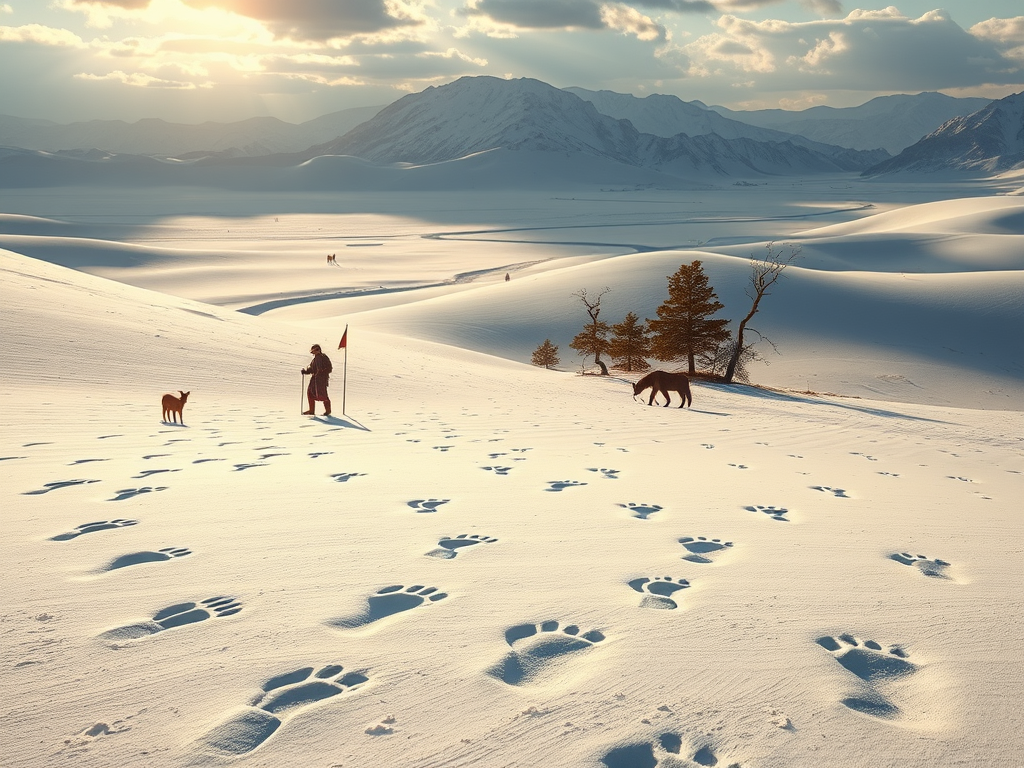
One of the most consequential discoveries on U.S. soil is not a spear point or a settlement foundation, but footprints: trackways preserved in gypsum sediments at White Sands in New Mexico. As reported in Science, the evidence indicates humans were present during the Last Glacial Maximum, earlier than long-dominant timelines allowed.
Because the claim is so disruptive, it has been tested aggressively. A later Science paper—explicitly framed as an independent attempt to resolve the dating controversy—adds additional lines of evidence that support the original age range.
A U.S. Geological Survey summary likewise describes new work supporting the 21,000–23,000-year age estimate and explains why independent confirmation matters when earlier methods are challenged.
The National Park Service’s White Sands interpretive material reflects this updated scientific consensus in plain language for the public.
Why this matters: If humans were in the interior Southwest during the Last Glacial Maximum, the “how” and “when” of peopling the Americas becomes less like a single corridor opening and more like a complex set of routes, timings, and adaptations—some likely coastal, some interior, and some opportunistic.
A note on what we can’t responsibly claim
Footprints are powerful evidence of presence, but they do not automatically reveal:
- the size of the population,
- the duration of occupation,
- or the full migration route(s) that brought people there.
This is why the White Sands record is often described as evidence of people rather than proof of a specific culture in the way archaeologists use that term.
From presence to permanence: how life would have looked on the land
A realistic portrait of the earliest people on this land is not a “primitive” caricature. It is people doing what humans do everywhere:
- tracking animals and seasonal plants,
- moving to follow water and resources,
- and building social knowledge that accumulates across generations.
Over time, that knowledge becomes infrastructure: trails, exchange networks, food-production strategies, and eventually cities.
Bridge to Part II: If Part I is about the first provable human presence, Part II is about what happens when presence becomes world-building—dense societies, long-distance trade, and political power rooted in specific landscapes.