
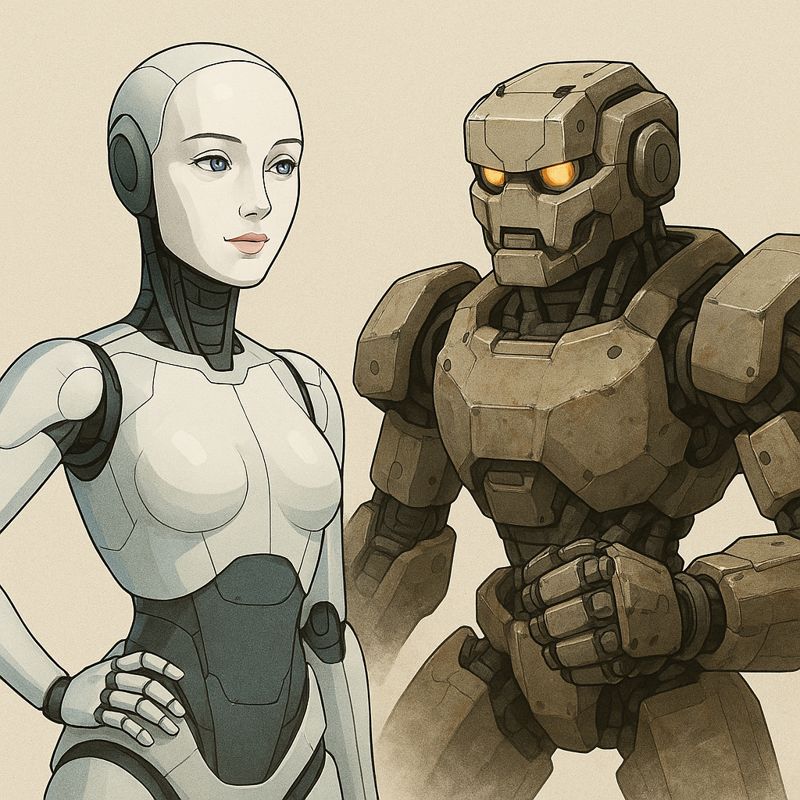
Scroll through YouTube Shorts for five minutes and it feels as if the future has already arrived. Robots spar like kickboxers, machine “soldiers” march on borders, and eerily perfect “women” blink at the camera claiming to be artificial wives from China. It is easy to come away thinking, This is it. The age of Terminators and android partners is here.
The reality is more complicated – and also more interesting. What you are seeing is a cocktail: some very real Chinese breakthroughs, some exaggerated marketing, and a lot of clever fakery layered on top.
The fighting robots: real metal, not movie magic
China really does have humanoid machines that can fight – but at this stage they punch for sport and show, not for battlefield glory.
- EngineAI’s “T800”
A Chinese start-up has openly named its full-size humanoid robot “T800”, borrowing the label from the Terminator films.- Built like an iron boxer: strong joints, metal shell, tuned to take hits.
- Marketed as “combat-ready”, but for robot fighting competitions and stress-tests, not for war.
- The key idea: if a robot can box, its motors are tough enough to survive falls, factory accidents and rough industrial work.
- Unitree and other Chinese makers
- Humanoids and four-legged robots from firms like Unitree are shown shadow-boxing, taking kicks and bouncing back.
- These videos are genuine demonstrations of balance, torque and stability, but they are tightly choreographed.
- The robots are not deciding to fight; they are following trained motion patterns or remote commands.
- Border robots on the China–Vietnam frontier
- Humanoid robots from UBTech (for example, the Walker S2 line) are being trialled along the Vietnam border.
- Their jobs: patrol, surveillance, carrying loads, checking fences, sometimes paired with robot dogs.
- They are hardware on duty, but their role is closer to a very advanced security guard than to a fully autonomous soldier.
Table 1 – What you’re actually seeing in “combat robot” clips
| Type of video | Likely origin | What’s real | What’s not happening (yet) |
|---|---|---|---|
| Humanoid doing kung fu / boxing | EngineAI, Unitree, UBTech demos | Real robot, real movements | Not an independent warfighter |
| Robot taking heavy kicks / punches | Corporate stress-test footage | Real impact test for balance and strength | Not a battlefield duel with humans |
| Humanoid with glowing eyes, firing guns | Edited Shorts, fan CGI, game footage | Often no real robot at all | No secret metal army marching at night |
The “robot wife” craze: the biggest hoax of all
If a robot looks too human – flawless skin, perfect lips, eyes that follow you like a drama heroine – treat the clip as suspect. Most viral “perfect female robots from China” fall into three buckets:
- Video game scenes
- Clips from titles like Detroit: Become Human are cut and re-captioned as “new Chinese AI wife released”.
- On a small phone screen, high-end CGI easily passes as reality.
- Human influencers pretending to be robots
- Models and performers use stiff movements, metallic make-up and rehearsed “glitches” to mimic androids.
- These performances are filmed at expos, car shows or movie promotions, then re-uploaded with misleading titles.
- Real animatronics with very limited range
- A few Chinese companies do make ultra-realistic heads and bodies with silicone skin.
- Up close, the illusion breaks; the movements are jerky and trapped in the “uncanny valley”.
- They are nowhere near the fluid, expressive “companions” shorts promise.
And this is not just about China. From Elon Musk “robot spouse” memes to European “AI girlfriend” gimmicks, clickbait channels around the world milk the same loneliness and curiosity to drive views.
Table 2 – Real robots vs “perfect” fake women online
| Feature | Genuine humanoid robots | Fake “female robots” on Shorts |
|---|---|---|
| Skin and face | Plastic/metal/polymer, clearly artificial | Smooth CGI skin or real human face |
| Motion | Slightly stiff, mechanical, cautious | Either too smooth (CGI) or too perfect (human) |
| Use case | Industry, labs, patrols, sports demos | “Wife”, “girlfriend”, “companion” clickbait |
| Country labels | China, US, Japan, Europe | Often randomly tagged “China” for virality |
A simple “chart in words”: three questions to ask before you believe a clip
Think of this as a mental chart you run in seconds while scrolling:
- Does the robot move like a gymnast or like a worker?
- If it’s doing flips and flying kicks: real demo, but staged.
- If it’s carefully sorting objects or folding things: that’s where real AI work is happening.
- Does the “woman robot” look better than a film character?
- If yes, assume CGI or a human actor first.
- Real humanoids still look slightly off, especially around the mouth and eyes.
- Is the promise too big?
- “Someone/some entity launches robot wives from next month.”
- “Someone/some entity/country secretly deploys killing machines in cities.”
- These sweeping/(unrealistic) claims should be seen as fun – not real things in – but as are warning signs.
Where does this leave a normal viewer?
For ordinary people, the confusion is understandable. We are living through a strange overlap:
- Some real Chinese robots are walking borders, sparring in rings and working in factories.
- Fake robots – especially “artificial partners” – are filling your feed with promises the technology simply cannot keep today.
- The safest rule: believe the strength and stamina you see in robots; doubt the romance and perfection you are sold in viral shorts.
You are not overreacting if you feel uneasy. Humanoid robots are moving from lab to real world faster than in most countries. But the scariest robots on your screen are still the ones inside editing software, not the ones walking the pavements.