
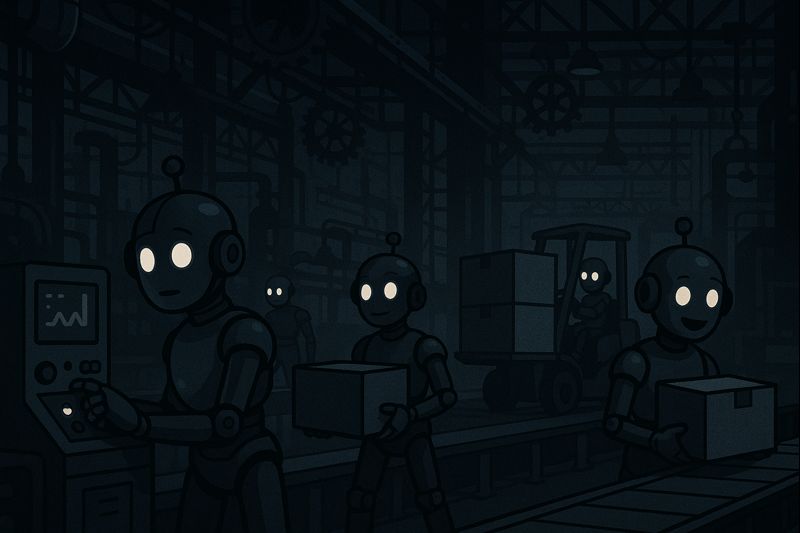
Behind those dramatic clips of Chinese robot dogs carrying rifles and humanoids trading blows lies another, quieter revolution: factories that run in darkness, robots that do not care if GPS is jammed, and an operating system built to keep Western software out.
The story is not just about one scary robot. It is about an entire ecosystem being built at high speed.
Robot fighting as a stress lab
When a company like EngineAI puts its “T800” robot into a boxing ring, it is not just chasing social media views. It is running a brutal engineering exam.
- High-impact punches test actuator torque and joint durability.
- Shoves and kicks test balance algorithms.
- Falls test the armour around batteries and control boards.
By turning all of this into a “robot fighting league”, Chinese firms get three things at once: data, free marketing and a pipeline into military and industrial contracts.
Robot dogs: from showpiece to armed scout
Four-legged robots, often nicknamed “robot dogs”, have moved fastest from lab to field.
- China
- Models like the Unitree Go2 or B1 have been shown carrying assault rifles in joint drills.
- They lead into buildings, peek around corners and expose themselves instead of human soldiers.
- United States
- Uses similar quadrupeds mainly for patrol and bomb work at bases.
- Weaponised versions have been tested but are not yet the norm.
- India
- The indigenous MULE programme focuses on mountain warfare, carrying loads and sensors in harsh terrain.
Table 3 – Battery life: robot dog vs human patrol
| Patrol “unit” | Typical endurance without rest/charge | What happens at the limit |
|---|---|---|
| Trained human soldier on patrol | 6–12 hours (with food and water) | Gradual fatigue, slower reaction |
| Mid-range military robot dog | ~2–4 hours of active movement | Sudden stop when battery is exhausted |
| UBTech-style border humanoid | A few hours, then auto battery swap | Walks to swap station, continues after change |
Robots work at full power and then die in an instant; humans slow down but do not “switch off” in one second. That is why China’s experiments with automatic battery swapping are so important. A robot that can change its own battery and return to patrol starts to chip away at that weakness.
How Chinese robots keep walking when GPS is jammed
In a serious war, GPS will be one of the first targets. Yet the new wave of Chinese robots does not collapse when satellite signals vanish.
They rely on two key ideas:
- LiDAR SLAM
- A spinning or solid-state laser scanner fires beams in all directions.
- The robot builds a 3D map of its surroundings while working out its own position inside that map.
- No satellite, no external signal – nothing for an enemy to jam.
- Visual odometry
- Multiple wide-angle cameras capture rapid-fire images.
- By comparing how objects shift between frames, the robot calculates how far it has moved.
- If the lasers struggle in smoke or dust, the cameras take over.
In more advanced units, if one robot has already mapped a building, the others can load that map and walk inside as if they have been there before. It is the beginnings of swarm intelligence, even without the internet.
Dark factories: where the lights genuinely go off
Away from borders, the same mindset is reshaping shop floors.
China is racing to build “dark factories” – lines so automated that no human needs to stand next to a machine. You can literally switch the lights off; robots do not complain.
A famous example is a smartphone “super factory” in Beijing:
- Phones roll off the line at roughly one per second.
- The production floor runs with no human workers, only robots and conveyor systems.
- Human staff sit in a separate control room watching data, not tightening screws.
Table 4 – Rough picture of very advanced factories
| Country/region | Advanced / “lighthouse” / dark-style factories (approximate) | Broad approach |
|---|---|---|
| China | 60+ | Replace humans where labour is shrinking |
| Europe (combined) | 25–30 | Blend automation with skilled human oversight |
| United States | 15–20 | Strong automation, but humans remain on floor |
| India | 10–12 | Selective automation; large young workforce |
China installs more industrial robots than any other country and pushes hardest for plants that can run without breaks, holidays or shifts.
The silent software war: OpenHarmony and M-Robots OS
Metal is only half the picture. For Beijing, Western software is now a strategic risk.
- The fear: if your robots and factories rely on Windows or Linux, foreign powers might hide a “kill switch” in the code.
- The answer: OpenHarmony (Hongmeng) – a home-grown operating system designed to rip out Western kernels.
Key features of this push:
- Newer Harmony versions are moving away from the Linux kernel entirely.
- A micro-kernel design keeps different functions isolated, so a crash in one area does not freeze the whole robot.
- A dedicated layer, M-Robots OS, is being built as a replacement for the widely used Robot Operating System (ROS), allowing different Chinese robots – drones, dogs, humanoids – to work together without foreign software in the loop.
In short, China is not just building its own robot bodies; it is building its own robot “language”.
Chips and the nuclear battery hype
US sanctions try to cripple Chinese AI by cutting off the most powerful Nvidia chips. That hurts the massive data-centre “teachers”, but it does not stop the smaller “doer” chips that actually sit inside robots. Chinese firms rely on:
- Imported or stockpiled Nvidia Jetson-class modules, sometimes obtained indirectly.
- Domestic AI chips from companies like Huawei and Horizon Robotics, which are good enough for most on-board tasks.
On the power side, headlines about a nuclear battery that runs for fifty years sound terrifying. The BV100 from Betavolt is a real device: a tiny nickel-63 based cell that can quietly generate energy for decades. The catch is brutal:
- It delivers microwatts, not watts.
- Perfect for long-lived sensors or hidden listening devices.
- Useless for powering a fighting robot or a flying drone on its own.
It is less a robot heart and more a spy seed – small, patient and hard to find.
What this adds up to
Put together, this ecosystem looks like this:
- Robots – humanoid and four-legged – that can work and patrol, even without GPS.
- Factories that can stay dark and humming while humans monitor them from screens.
- Operating systems and chips designed to keep Western influence out of the core.
- Power experiments that will first reshape invisible surveillance rather than visible machines.
For ordinary citizens, the important truth is this: China’s robot revolution is not science fiction any more, but it is also not the fantasy you see in the loudest shorts. The real revolution is quieter, in server rooms and factory lines, not just in viral clips.